


Cell Cycle/Checkpoint
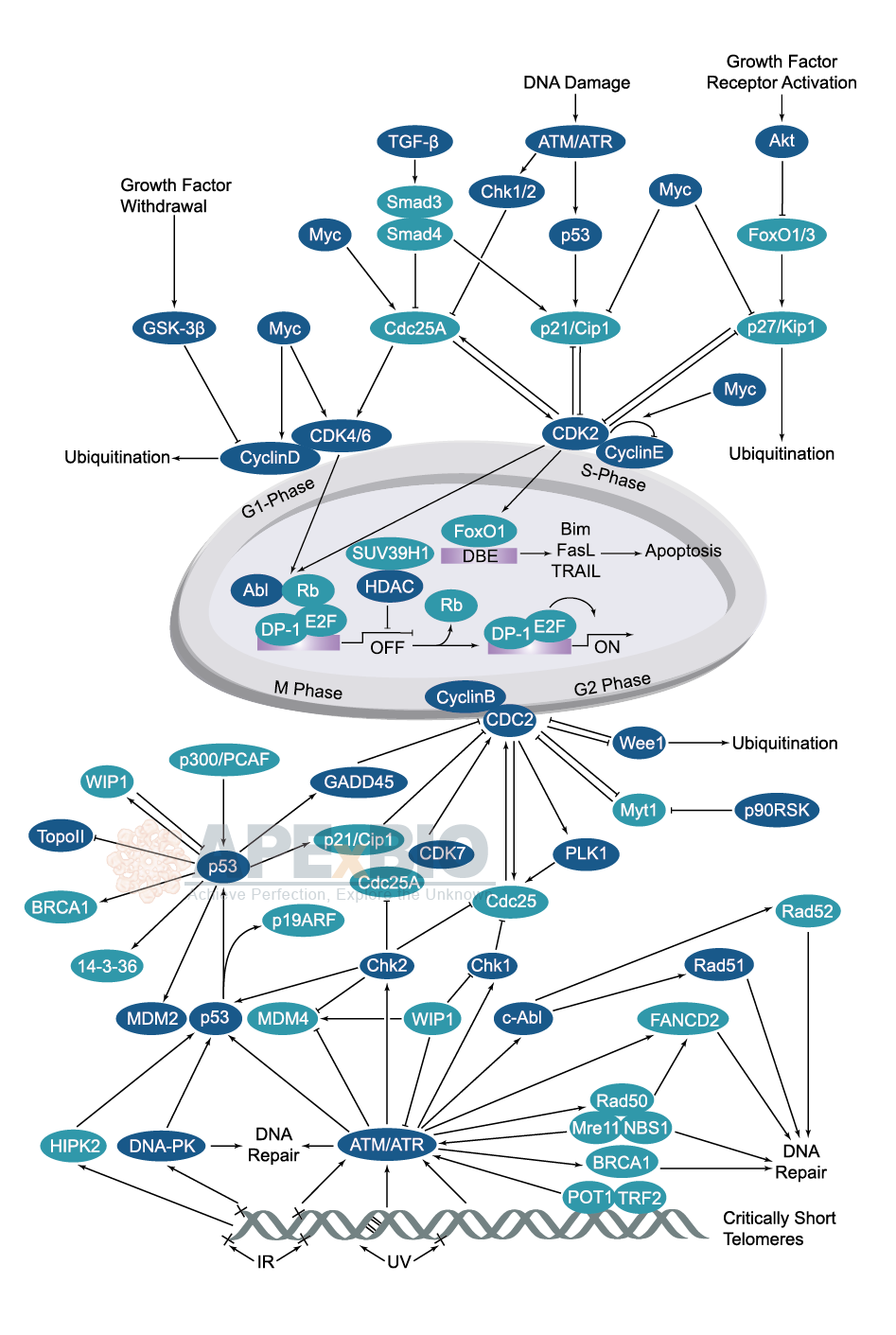
The cell cycle is consisted of 4 main phases: Gap 1 (G1), DNA replication (S), Gap 2 (G2), and mitosis (M). There are “checkpoints” mechanism regulates the transition between these phases, at the G1/S boundary, in the S-phase and during G2/M phases. Cell can only pass through these checkpoints when signaling factors are activated and free of DNA damage. Important proteins that control cell cycle events and checkpoints are cullins, cyclins, cyclin-dependent kinases (Cdks), p53 and their inhibitors etc. Cdks family (Cdk2, Cdk3, Cdk4 and Cdk6) are Ser/Thr kinases that regulate cell cycle progression in association with cyclin binding partners (cyclin D, cyclin E and cyclin A) during all four phases. p53 halts the cell cycle if the DNA is damaged and allowing time for DNA repair to progress; it can also initiate apoptosis if DNA damage is too severe to be repaired.
-
 BA5944 VudalimabSummary: Vudalimab is a potent and dual inhibitor, a fully humanized bispecific monoclonal antibody.
 -
BA5947 TuvonralimabSummary: Tuvonralimab (PSB-205; QL1706) is a dual immune checkpoint blocker.
-
BA6140 CA-170Summary: CA-170 is an oral dual inhibitor.
-
BA6145 LatikafuspSummary: Latikafusp (AMG256) is a bifunctional fusion protein containing targeted antibodies and mutant proteins designed to provide pathway stimulation to PD-1+ cells.
-
BA6146 AcasunlimabSummary: Acasunlimab (GEN1046) is a bispecific antibody (bsAb) that targets and.
-
BA6147 D18Summary: D18 is an immunomodulator.
-
BA6149 TPP-1Summary: TPP-1 is a potent inhibitor of the interaction.
-
BA6150 BMS-37Summary: BMS-37 is an immune checkpoint inhibitor.
-
BA6151 TagitanlimabSummary: Tagitanlimab has the potential to study recurrent or metastatic nasopharyngeal carcinoma (NPC).
-
BA6152 PD-1-IN-24Summary: Inhibitors with oral activity.