


Cell Cycle/Checkpoint
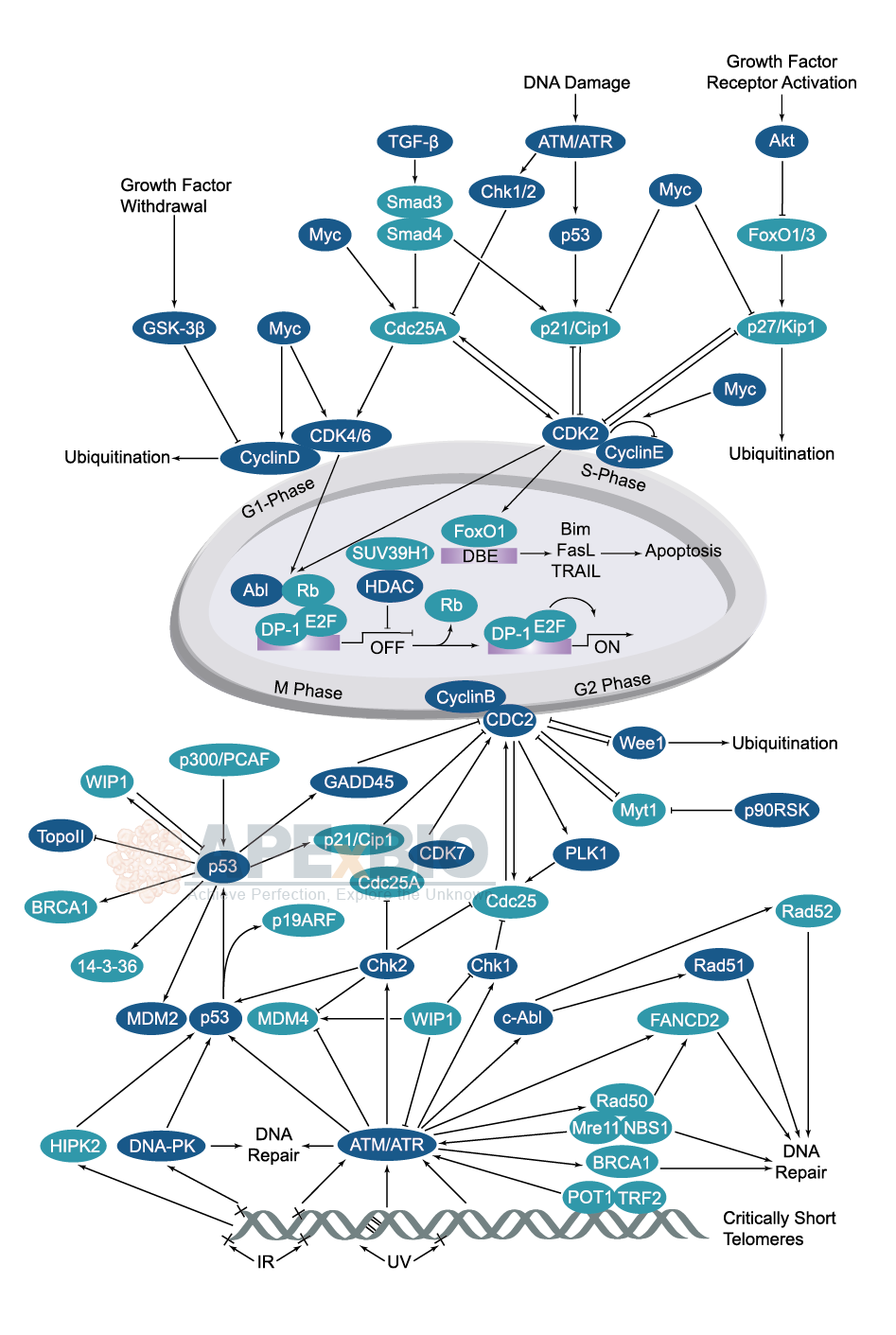
The cell cycle is consisted of 4 main phases: Gap 1 (G1), DNA replication (S), Gap 2 (G2), and mitosis (M). There are “checkpoints” mechanism regulates the transition between these phases, at the G1/S boundary, in the S-phase and during G2/M phases. Cell can only pass through these checkpoints when signaling factors are activated and free of DNA damage. Important proteins that control cell cycle events and checkpoints are cullins, cyclins, cyclin-dependent kinases (Cdks), p53 and their inhibitors etc. Cdks family (Cdk2, Cdk3, Cdk4 and Cdk6) are Ser/Thr kinases that regulate cell cycle progression in association with cyclin binding partners (cyclin D, cyclin E and cyclin A) during all four phases. p53 halts the cell cycle if the DNA is damaged and allowing time for DNA repair to progress; it can also initiate apoptosis if DNA damage is too severe to be repaired.
-
 BA4318 5-EthyluridineSummary: 5-Ethyluridine is a purine nucleoside analog.
 -
BA4320 3-Azido-3-deoxyadenosineSummary: 3'-Azido-3'-deoxyadenosine is a purine nucleoside analog.
-
BA4321 2-ThiothymidineSummary: 2-Thiothymidine is a purine nucleoside analog.
-
BA4322 2-C-methyluridineSummary: 2'-C-methyluridine is a uracil nucleoside analog.
-
BA4323 Alpha-AdenosineSummary: Alpha-Adenosine is a purine nucleoside analog.
-
BA4324 5-DMT-2-O-TBDMS-N1-Methyl-PseudoUridine-CE-PhosphoramiditeSummary: 5'-DMT-2'-O-TBDMS-N1-Methyl-PseudoUridine-CE-Phosphoramidite is a purine nucleoside analog.
-
BA4325 L-InosineSummary: L-Inosine is in the L-configuration form.
-
BA4326 3-DeoxycytidineSummary: 4-Amino-1-((2R,3R,5S)-3-hydroxy-5-(hydroxymethyl)tetrahydrofuran-2-yl)pyrimidin-2(1H)-one (3'-Deoxycytidine) is a purine nucleoside analog.
-
BA4327 6-O-MethyldeoxyguanosineSummary: O6-Methyldeoxyguanosine;DNAadduct is a purine nucleoside analog.
-
BA4328 4-C-AzidouridineSummary: 4'-C-azidouridine (4'-Azidouridine) is a uracil nucleoside analog.