
Streptavidin – FITC
Catalog No.
K1081
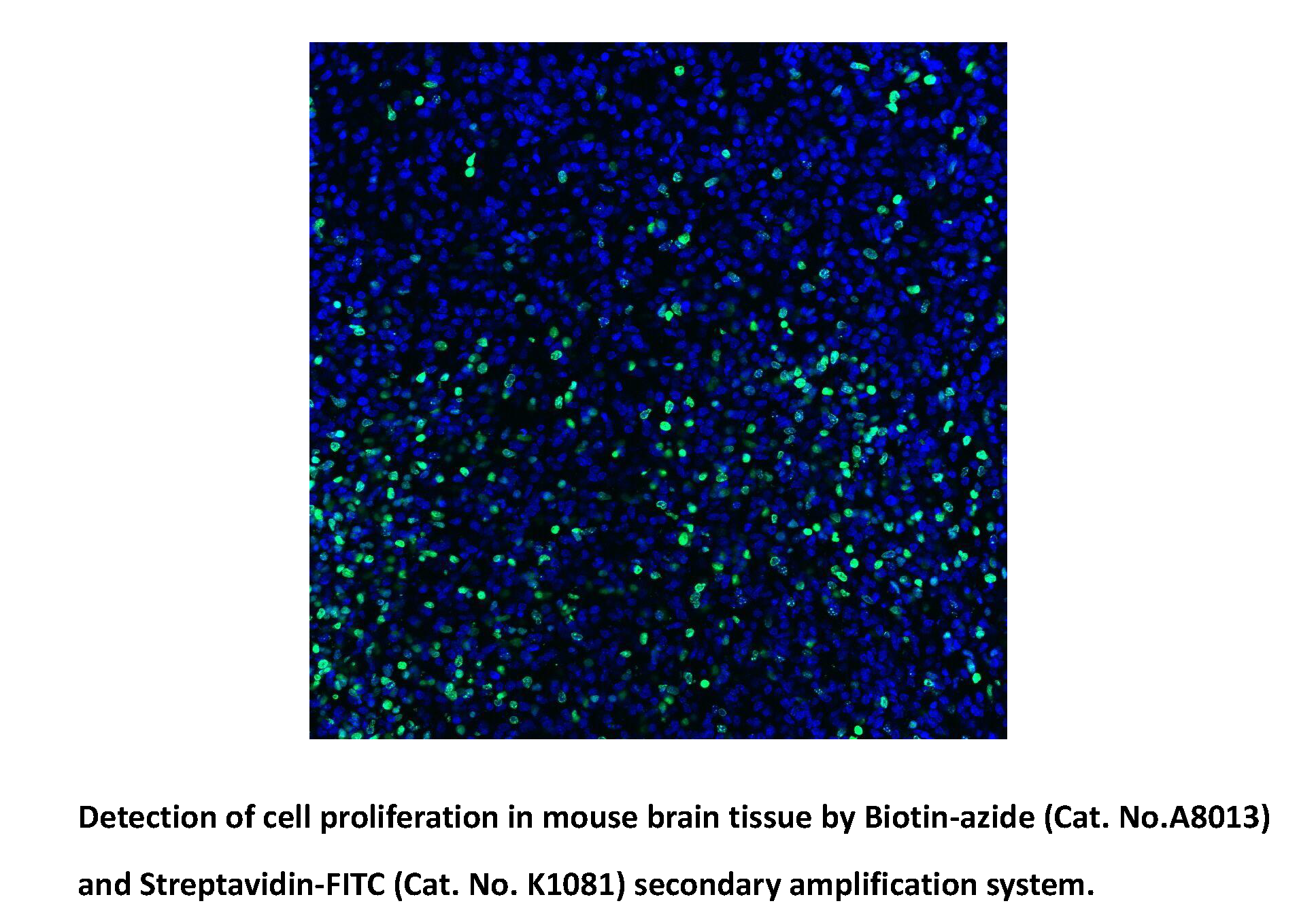
Streptavidin-FITC conjugate for fluorescent detection of biotinylated antibodies, proteins, nucleic acids, or other molecules
Featured Products
Streptavidin is a tetrameric protein with a molecular weight of approximately 52,800 daltons. It exhibits extremely high affinity for biotin, with each streptavidin molecule capable of binding up to four biotin molecules in an irreversible manner. Streptavidin-FITC is used for detecting biotinylated antibodies, proteins, nucleic acids, or other molecules, and can be applied in immunohistochemistry (IHC), immunocytochemistry (ICC), immunofluorescence (IF), in situ hybridization (ISH), or flow cytometry. FITC serves as a fluorescent label, having a maximal excitation at 488 nm and maximal emission at approximately 520 nm.
- 1. Li Xiao, Tao Gong, et al. "ST3GAL1 mediates sialylation to promote adhesion of Fusobacterium nucleatum to colorectal cancer cells." Biochim Biophys Acta Mol Basis Dis. 2026 Jun 24;1872(7):168332. PMID: 42342164
- 2. Siyang Zuo, Huixiong Yuan, et al. "SMYD2 Promotes Renal Tubular Cell Apoptosis and Chronic Kidney Disease Following Cisplatin Nephrotoxicity." FASEB J. 2025 May 31;39(10):e70651. PMID: 40391402
- 3. Shaokai Zheng, Nannan Zhao, et al. "Fine particulate matter (PM2.5) and the blood-testis-barrier: an in vivo and in vitro mechanistic study." Environ Health Perspect. 2025 Apr;133(3-4):47006. PMID: 40043229
- 4. Chengzhi Luo, Yunfei Li, et al. "Intracellular trafficking of lipid nanoparticles is hindered by cholesterol." Int J Pharm. 2025 Jan 16:671:125240. PMID: 39826779
- 5. Wenjing Wang, Hongyang Guo, et al. "Silicon-rhodamine-enabled identification for near-infrared light controlled proximity labeling in vitro and in vivo." Nature Communications volume 16, Article number: 8134, 30 August(2025)
- 6. Xiaoping Ye, Xinping Li, et al. "Alpha‐ketoglutarate ameliorates age‐related and surgery induced temporomandibular joint osteoarthritis via regulating." Aging Cell. 2024 Nov;23(11):e14269. PMID: 38992995
Related Biological Data
Store at 2-8°C. Light exposure should be avoided. Do not freeze.