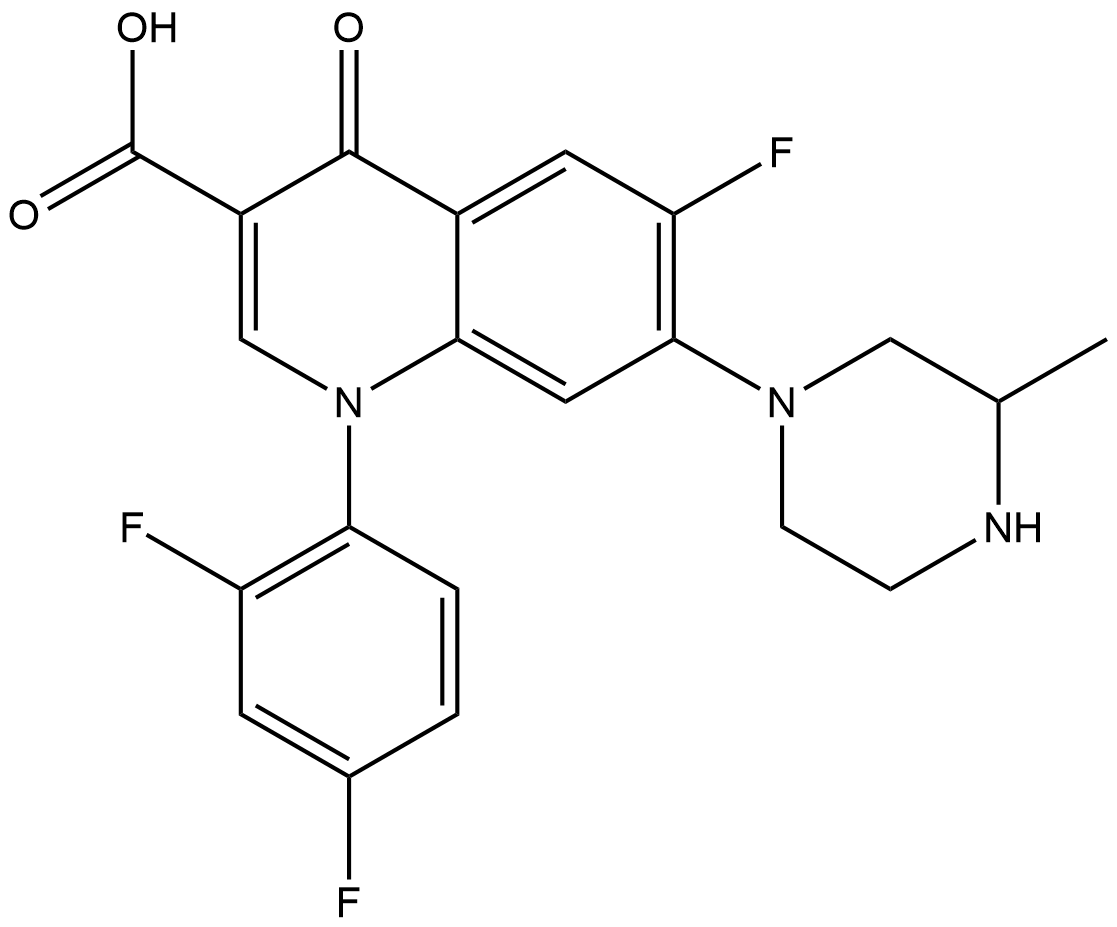
Temafloxacin
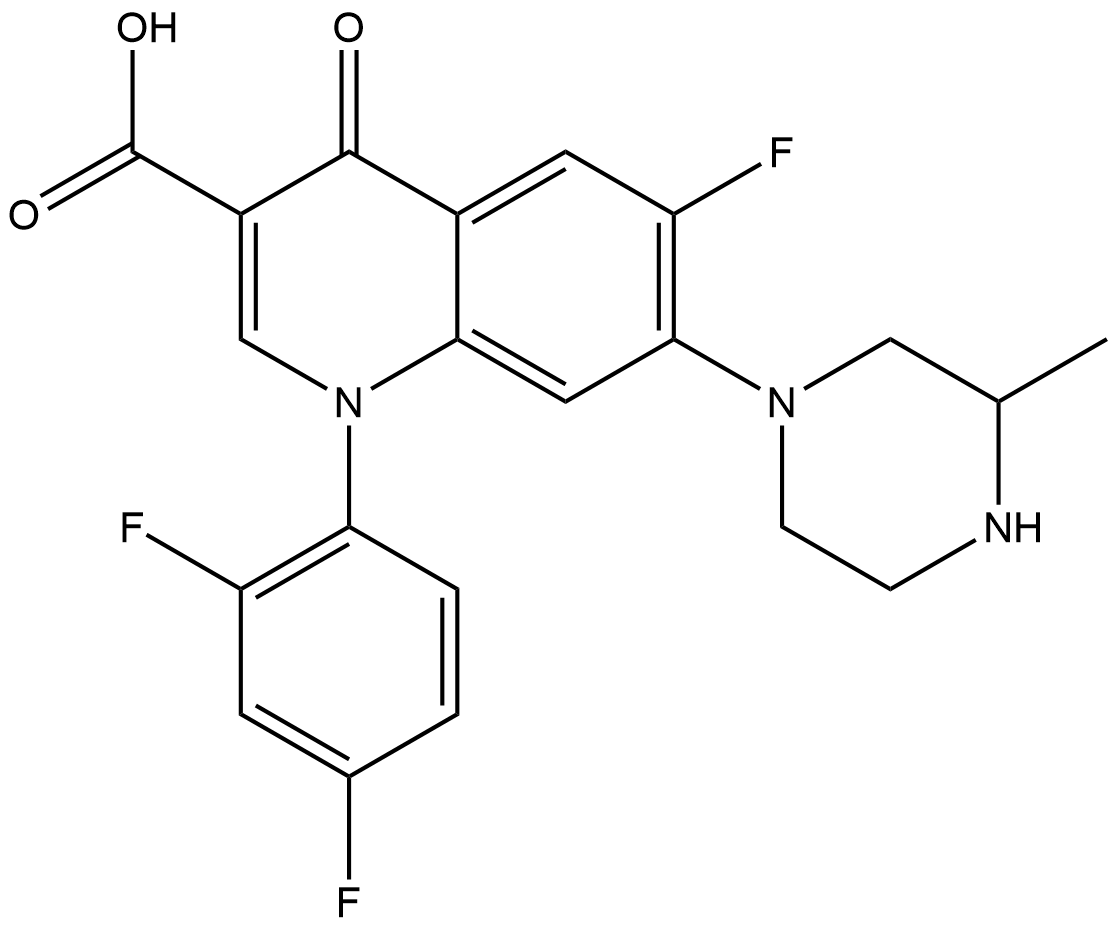
Temafloxacin (CAS No. 108319-06-8) is a fluoroquinolone broad-spectrum antibacterial agent whose core bioactivity is inhibition of bacterial DNA replication and transcription, targeting bacterial DNA gyrase (gyrA subunit) and topoisomerase IV (Topoisomerase IV). It is active against Gram-positive bacteria, Gram-negative bacteria, and pathogens such as Chlamydia and Mycoplasma. The MIC is pathogen-specific. Among Gram-negative bacteria, the MIC?? for Haemophilus influenzae is ≤0.03 μg/mL, for Neisseria gonorrhoeae MIC?? ≤0.015 μg/mL, for Neisseria meningitidis MIC?? ≤0.015 μg/mL, for most Enterobacteriaceae strains MIC?? ≤0.5 μg/mL, and for Pseudomonas aeruginosa MIC?? is about 4 μg/mL. Among Gram-positive bacteria, the MIC?? for Streptococcus pneumoniae is ≤1 μg/mL, for Staphylococcus aureus (including MRSA) MIC?? ≤0.25 μg/mL, and for Streptococcus pyogenes MIC?? ≤0.5 μg/mL. For Chlamydia (e.g., Chlamydia trachomatis) MIC?? = 0.25 μg/mL, and for Mycobacterium avium complex (chromogenic type) the mean MIC is 4 μg/mL. Commonly used application concentrations: for in vitro antibacterial testing using the agar dilution method, a concentration range of 0.002~32 μg/mL is applied; for intracellular bactericidal assays against mycobacteria, 4 μg/mL is used. In animal experiments, in a mouse pneumonia model, oral administration shows anti-pneumococcal activity equivalent or superior to erythromycin. Clinically effective therapeutic concentrations correspond to oral doses: in adults, typically 400 mg once or twice daily, or 600 mg twice daily, which can be taken fasting or with food. After a single 400 mg oral dose, the peak plasma concentration is about 3.3 mg/L, blister fluid penetration is 104.5%, bronchial mucosal concentration reaches 12.2 mg/kg, the 26-hour urinary excretion rate is 51.8%, and serum and tissue concentrations remain above the MIC?? of most pathogenic bacteria. It is suitable for infections of the respiratory tract, genitourinary tract, and gastrointestinal tract. Caution is required to avoid co-administration with magnesium/aluminum-containing antacids, and in patients with renal insufficiency (creatinine clearance < 40 mL/min) the dosing interval needs adjustment.
References:
[1] Nye K, Shi YG, Andrews JM, Ashby JP, Wise R. The in-vitro activity, pharmacokinetics and tissue penetration of temafloxacin. J Antimicrob Chemother. 1989 Sep;24(3):415-24. doi: 10.1093/jac/24.3.415. PMID: 2808194.
[2] Dudley MN. A review of the pharmacokinetic profile of temafloxacin. J Antimicrob Chemother. 1991 Dec;28 Suppl C:55-64. doi: 10.1093/jac/28.suppl_c.55. Erratum in: J Antimicrob Chemother 1992 Jun;29(6):735. PMID: 1664830.
[3] Mandell LA, Lawrence T, Rotstein C, Gorzynski EA, Beam TR, Amsterdam D. The in-vitro activity of temafloxacin, against gram-positive bacteria. J Antimicrob Chemother. 1991 Dec;28 Suppl C:15-24. doi: 10.1093/jac/28.suppl_c.15. PMID: 1664826.
[4] Hardy DJ. In vitro activity of temafloxacin against gram-negative bacteria: an overview. Am J Med. 1991 Dec 30;91(6A):19S-23S. doi: 10.1016/0002-9343(91)90304-g. PMID: 1662890.
[5] Gevaudan MJ, Bollet C, Mallet MN, de Micco P. In-vitro evaluation of clarithromycin, temafloxacin, and ethambutol in combination against Mycobacterium avium complex. J Antimicrob Chemother. 1993 May;31(5):725-30. doi: 10.1093/jac/31.5.725. PMID: 8392998.
| Physical Appearance | A solid |
| Storage | -20°C |
| M.Wt | 417.38 |
| Cas No. | 108319-06-8 |
| Formula | C21H18F3N3O3 |
| Synonyms | TMFX;TA-167 free acid;A-62254 free acid |
| Solubility | ≥6.54 mg/mL in DMSO with ultrasonic; insoluble in EtOH; insoluble in H2O |
| Chemical Name | 1-(2,4-difluorophenyl)-6-fluoro-7-(3-methylpiperazin-1-yl)-4-oxo-1,4-dihydroquinoline-3-carboxylic acid |
| Canonical SMILES | O=C(O)C1=CN(C2=C(F)C=C(F)C=C2)C3=CC(N4CC(C)NCC4)=C(F)C=C3C1=O |
| Shipping Condition | Small Molecules with Blue Ice, Modified Nucleotides with Dry Ice. |
| General tips | We do not recommend long-term storage for the solution, please use it up soon. |
Quality Control & MSDS
- View current batch:
Chemical structure