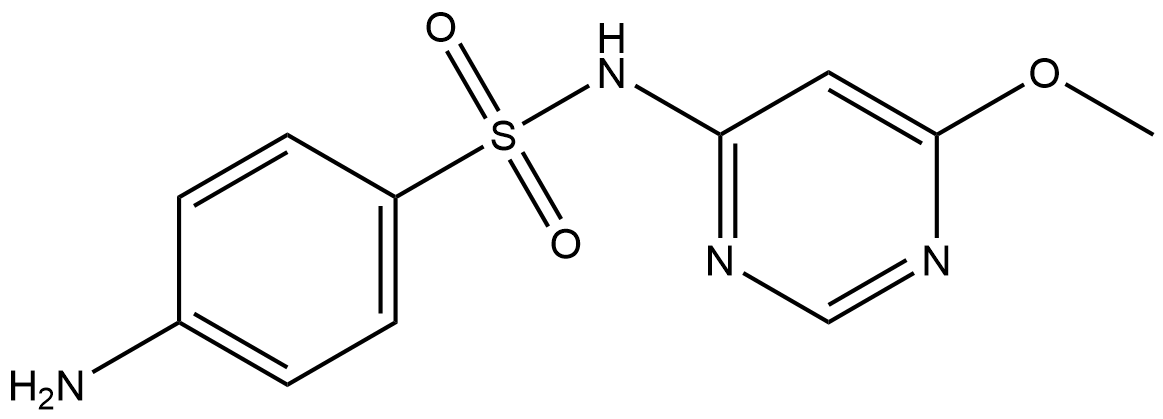
Sulfamonomethoxine
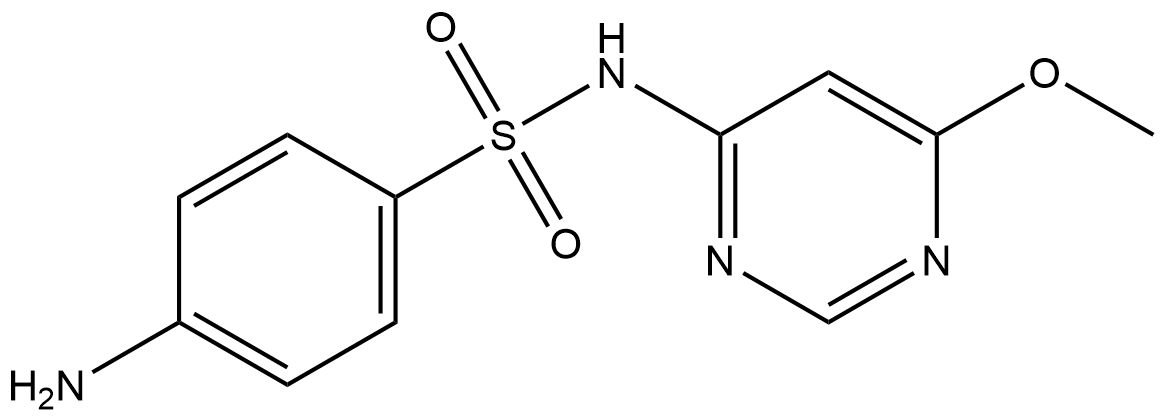
Sulfamonomethoxine (CAS No. 1220-83-3) is a broad-spectrum sulfonamide antibiotic whose core biological activity is inhibition of folic acid biosynthesis in bacteria and protozoa, targeting dihydropteroate synthase (DHPS). It is also toxic to a variety of aquatic organisms and can be degraded via biotransformation in aerobic granular sludge systems. EC50/LC50 values are species-specific: for the freshwater microalga Chlorella vulgaris, the 72-h growth inhibition EC50 is 5.9 mg/L; for the marine microalga Isochrysis galbana, 9.7 mg/L; for the cladoceran Daphnia magna, the 48-h acute toxicity LC50 is 48 mg/L and the 21-day reproduction inhibition EC50 is 14.9 mg/L; for Daphnia similis, the 48-h LC50 is 283 mg/L and the 21-day EC50 is 41.9 mg/L; for the freshwater fish Oryzias latipes, the 96-h LC50>1000 mg/L; and for the protozoan Azumiobodo hoyamushi, the 24-h EC50>100 mg/L. Common application concentrations: in vitro toxicity tests use gradient concentrations of 0.5~800 mg/L (algae, cladocerans, fish); environmental biotransformation experiments use 500 μg/L. In veterinary medicine and aquaculture it is used as a feed additive or therapeutic drug, and environmental detection concentrations can reach up to 100 μg/L. Its applications are focused on prevention and treatment of bacterial infections in livestock, poultry, and aquaculture, exerting its effect by inhibiting folate synthesis in pathogens. After injection in sheep, about 5.8~15.3% is excreted in urine. In aerobic granular sludge, it can undergo biotransformation mediated by hydroxylamine and cometabolic degradation via ammonia monooxygenase (AMO) and cytochrome P450.
References:
[1] Park KH, Zeon SR, Lee JG, Choi SH, Shin YK, Park KI. In vitro and in vivo efficacy of drugs against the protozoan parasite Azumiobodo hoyamushi that causes soft tunic syndrome in the edible ascidian Halocynthia roretzi (Drasche). J Fish Dis. 2014 Apr;37(4):309-17. doi: 10.1111/jfd.12104. Epub 2013 Aug 17. PMID: 23952334.
[2] Huang DJ, Hou JH, Kuo TF, Lai HT. Toxicity of the veterinary sulfonamide antibiotic sulfamonomethoxine to five aquatic organisms. Environ Toxicol Pharmacol. 2014 Nov;38(3):874-80. doi: 10.1016/j.etap.2014.09.006. Epub 2014 Sep 16. PMID: 25461547.
[3] Ishikawa NK, Takahashi K, Sakakibara T, Nomura S, Ito A. Degradation of sulfamonomethoxine in solution using pulsed plasma discharge - identification of by-products and toxicity of treated solution to green algae. Water Sci Technol. 2022 Nov;86(9):2430-2440. doi: 10.2166/wst.2022.341. PMID: 36378190.
[4] Li MY, Zhang RD, Lin YX, Li QW, Zhao QY, Zhao ZX, Ling ZM, Shu LF, Zhang M, Hu LX, Shi YJ, Ying GG. Biotransformation of sulfamonomethoxine in a granular sludge system: Pathways and mechanisms. Chemosphere. 2023 Feb;313:137508. doi: 10.1016/j.chemosphere.2022.137508. Epub 2022 Dec 6. PMID: 36493889.
| Physical Appearance | A solid |
| Storage | -20°C |
| M.Wt | 280.30 |
| Cas No. | 1220-83-3 |
| Formula | C11H12N4O3S |
| Synonyms | Sulfamonomethoxin; SMM |
| Solubility | ≥54 mg/mL in DMSO; ≥2.52 mg/mL in EtOH with ultrasonic; insoluble in H2O |
| Chemical Name | 4-amino-N-(6-methoxypyrimidin-4-yl)benzenesulfonamide |
| Canonical SMILES | O=S(C1=CC=C(N)C=C1)(NC2=NC=NC(OC)=C2)=O |
| Shipping Condition | Small Molecules with Blue Ice, Modified Nucleotides with Dry Ice. |
| General tips | We do not recommend long-term storage for the solution, please use it up soon. |
Quality Control & MSDS
- View current batch:
Chemical structure