


Icatibant Acetate
Icatibant acetate (HOE 140, CAS No. 138614-30-9) is a highly selective, competitive antagonist of the bradykinin B2 receptor (B2R), with no activity at the B1 receptor. Its principal pharmacological action is the inhibition of bradykinin-mediated increases in vascular permeability, release of inflammatory mediators, and smooth muscle contraction. Clinically, it is primarily used for the treatment of acute attacks of hereditary angioedema (HAE), and it has also been applied in angioedema induced by angiotensin-converting enzyme inhibitors (ACEIs) as well as in investigational adjunctive therapy for viral infections (e.g., COVID-19, hantavirus infection).
Its IC50/Ki values are context-dependent. In receptor binding assays, the IC50 and Ki in guinea pig ileum are 1.07 nM and 0.798 nM, respectively. It inhibits bradykinin-induced intracellular calcium elevation with an IC50 of 1 nM and endothelium-derived relaxing factor (EDRF) release with an IC50 of 10 nM. In human synovial cells, the pKi and pKB values are 8.4 and 8.1, respectively, and the pIC50 values for inhibition of IL-6 and IL-8 release are 6.6 and 6.7, respectively.
Commonly used concentrations in experimental settings are as follows: in vitro organ studies (e.g., guinea pig ileum, rat uterus) typically employ IC50 values in the range of 4.9–11 nM; cellular experiments (e.g., human synovial cells, endothelial cells) generally use 1 nM to 10 μM; in animal studies (e.g., hantavirus infection models) a single subcutaneous dose of 30 mg is administered, which may be repeated after 6 hours. In clinical practice for HAE, adults typically receive a single subcutaneous dose of 30 mg (up to 3 doses within 24 hours), whereas pediatric doses are adjusted according to body weight (e.g., 10 mg for 12–25 kg, 15 mg for 26–40 kg, etc.). In clinical studies of COVID-19 pneumonia, a regimen of 30 mg subcutaneously three times daily for 3 consecutive days has been used, and in ACEI-induced angioedema a single subcutaneous 30 mg dose is typically administered.
The effective therapeutic exposure corresponds to a single 30 mg subcutaneous dose in adults with acute HAE attacks and weight-adjusted dosing in children. For viral infections, early administration appears to be critical. In ACEI-induced angioedema, a single 30 mg subcutaneous injection can relieve symptoms within several hours. Icatibant is generally well tolerated; the most common adverse events are local injection-site reactions (e.g., pruritus, pain). Contraindications include active ischemic heart disease and recent ischemic stroke.
References:
[1] Hock FJ, Wirth K, Albus U, Linz W, Gerhards HJ, Wiemer G, Henke S, Breipohl G, König W, Knolle J, et al. Hoe 140 a new potent and long acting bradykinin-antagonist: in vitro studies. Br J Pharmacol. 1991 Mar;102(3):769-73. doi: 10.1111/j.1476-5381.1991.tb12248.x. PMID: 1364851; PMCID: PMC1917958.
[2] Chan SK, Rudd JA. Role of bradykinin B2 receptors in the modulation of the peristaltic reflex of the guinea pig isolated ileum. Eur J Pharmacol. 2006 Jun 6;539(1-2):108-15. doi: 10.1016/j.ejphar.2006.04.002. Epub 2006 Apr 6. PMID: 16650846.
[3] Bellucci F, Cucchi P, Catalani C, Giuliani S, Meini S, Maggi CA. Novel effects mediated by bradykinin and pharmacological characterization of bradykinin B2 receptor antagonism in human synovial fibroblasts. Br J Pharmacol. 2009 Dec;158(8):1996-2004. doi: 10.1111/j.1476-5381.2009.00511.x. PMID: 20050188; PMCID: PMC2807661.
[4] Yamada Y, Iwasaki M, Usui H, Ohinata K, Marczak ED, Lipkowski AW, Yoshikawa M. Rapakinin, an anti-hypertensive peptide derived from rapeseed protein, dilates mesenteric artery of spontaneously hypertensive rats via the prostaglandin IP receptor followed by CCK(1) receptor. Peptides. 2010 May;31(5):909-14. doi: 10.1016/j.peptides.2010.02.013. Epub 2010 Feb 25. PMID: 20188776.
[5] Montinaro V, Cicardi M. ACE inhibitor-mediated angioedema. Int Immunopharmacol. 2020 Jan;78:106081. doi: 10.1016/j.intimp.2019.106081. Epub 2019 Dec 10. PMID: 31835086.
[6] Caballero T. Treatment of Hereditary Angioedema. J Investig Allergol Clin Immunol. 2021 Feb;31(1):1-16. doi: 10.18176/jiaci.0653. PMID: 33602658.
[7] Mustonen J, Antonen J, Vaheri A. Icatibant in viral infections. Infect Dis (Lond). 2023 Jun;55(6):444-445. doi: 10.1080/23744235.2023.2200563. Epub 2023 Apr 17. PMID: 37067851.
| Storage | Store at -20°C sealed, dry and away from light |
| M.Wt | 1364.57 |
| Cas No. | 138614-30-9 |
| Formula | C61H93N19O15S |
| Synonyms | HOE 140 |
| Solubility | ≥11.43 mg/mL in DMSO; ≥50.8 mg/mL in EtOH; ≥51.4 mg/mL in H2O |
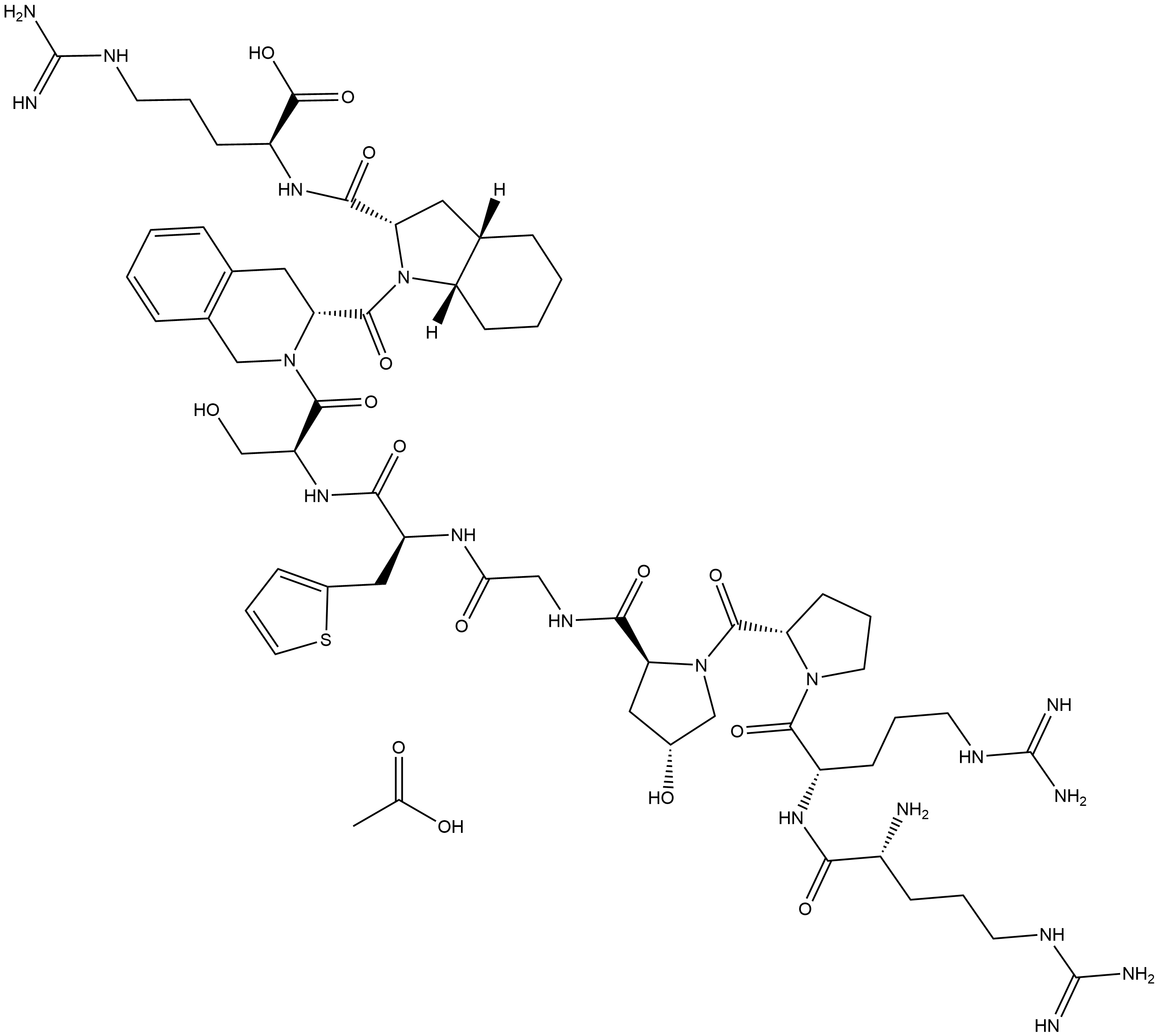
| Chemical Name | ((2S,3aS,7aS)-1-((R)-2-(((S)-2-(2-((2S,4R)-1-(D-arginyl-L-arginyl-L-prolyl)-4-hydroxypyrrolidine-2-carboxamido)acetamido)-3-(thiophen-2-yl)propanoyl)-L-seryl)-1,2,3,4-tetrahydroisoquinoline-3-carbonyl)octahydro-1H-indole-2-carbonyl)-L-arginine--acetic aci |
| Canonical SMILES | CC(O)=O.O=C([C@@H]1N(CC2=CC=CC=C2C1)C([C@H](CO)NC([C@@H](NC(CNC([C@H]3N(C[C@H](O)C3)C([C@H]4N(CCC4)C([C@H](CCCNC(N)=N)NC([C@H](N)CCCNC(N)=N)=O)=O)=O)=O)=O)CC5=CC=CS5)=O)=O)N6[C@]7([H])[C@](CCCC7)([H])C[C@H]6C(N[C@H](C(O)=O)CCCNC(N)=N)=O |
| Shipping Condition | Small Molecules with Blue Ice, Modified Nucleotides with Dry Ice. |
| General tips | We do not recommend long-term storage for the solution, please use it up soon. |
Quality Control & MSDS
- View current batch:
Chemical structure
