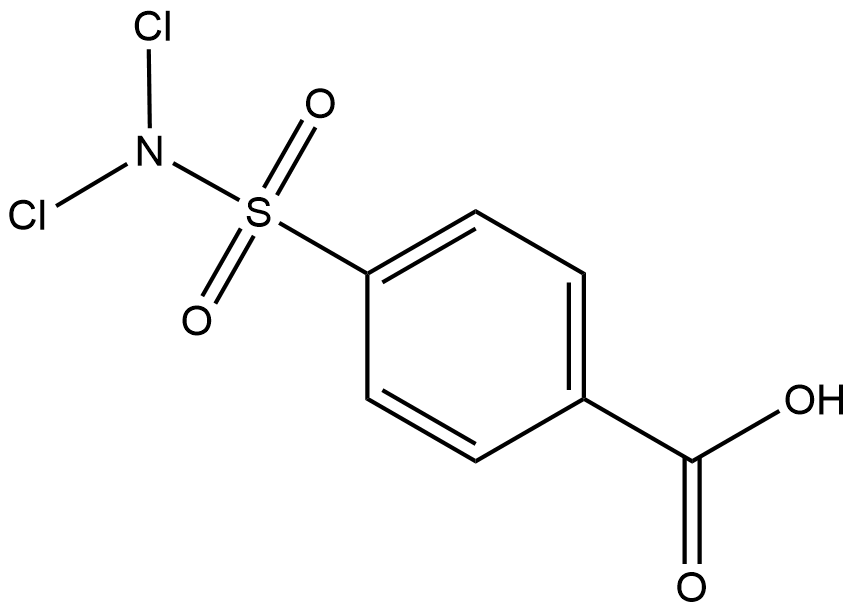
Halazone
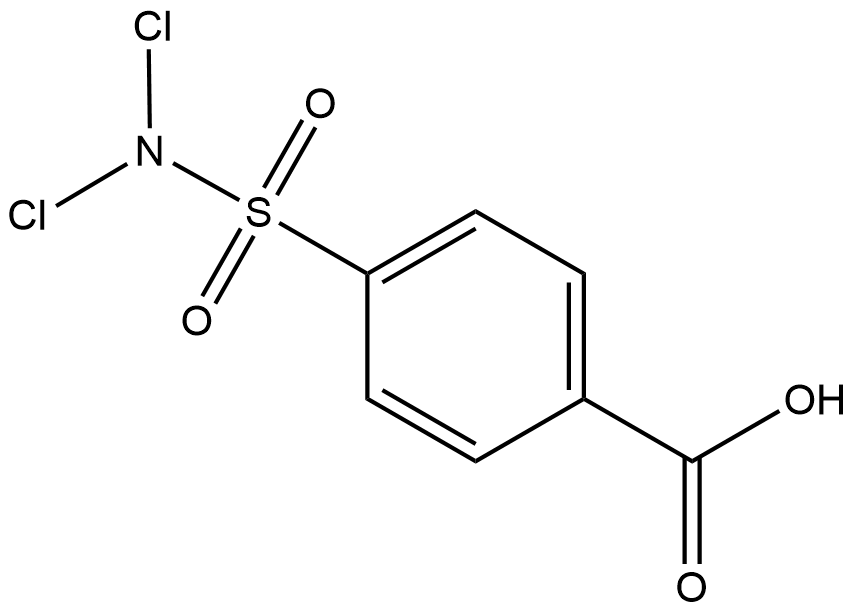
Halazone (CAS No. 80-13-7) is an organic chloramine broad-spectrum bactericidal disinfectant. Its core bioactivities are water disinfection/sterilization and modulation of neuronal sodium channel function. Its targets include bacterial cell membranes/metabolic systems (exerting oxidative bactericidal effects via release of hypochlorous acid, HOCl) and sodium channels in myelinated frog nerve fibers (inhibiting sodium current inactivation by modifying double bonds in membrane lipids); the MIC against Escherichia coli (E. coli) requires an effective chlorine concentration > 1.0 mg Cl?/L (corresponding to a Halazone concentration of about 1.0 mg/L or higher) to achieve complete kill within 3 minutes, and the redox potential must be > 455 mV; commonly used application concentrations: 0.4~1.0 mg/L for in vitro antibacterial tests (water disinfection scenarios), 5 mM in neurophysiological experiments (pH 7.2, exposure for 10 minutes), and in animal experiments, daily oral doses of 100~200 mg in rabbits are non-toxic, with a single 500 mg dose showing no obvious adverse reactions; the clinically effective disinfection concentration is 4 mg Halazone per liter of drinking water (one 0.004 g tablet can disinfect 1 quart, about 0.95 L of water). After oral administration, it is quantitatively converted in the body to p-sulfonamidobenzoic acid (urinary recovery rate about 60%), and there is no clearly defined therapeutic clinical concentration (it is mainly used for drinking water disinfection rather than disease treatment). Its stability is affected by excipients: tablets prepared by mixing with dry borax or sodium carbonate show a decomposition rate < 7% at room temperature over 150 days, while decomposition is accelerated at high temperatures (40~50℃).
References:
[1] Dunham EK, Dakin HD. NOTE ON THE FATE OF HALAZONE IN THE ANIMAL BODY AND ON THE STABILITY OF TABLETS CONTAINING IT. Br Med J. 1917 Dec 15;2(2972):790-1. doi: 10.1136/bmj.2.2972.790-a. PMID: 20768853; PMCID: PMC2349656.
[2] Victorin K, Hellstr?m KG, Rylander R. Redox potential measurements for determining the disinfecting power of chlorinated water. J Hyg (Lond). 1972 Jun;70(2):313-23. doi: 10.1017/s0022172400022361. PMID: 4555890; PMCID: PMC2130045.
[3] Rack M, Rubly N, Waschow C. Effects of some chemical reagents on sodium current inactivation in myelinated nerve fibers of the frog. Biophys J. 1986 Oct;50(4):557-64. doi: 10.1016/S0006-3495(86)83495-6. PMID: 2430631; PMCID: PMC1329833.
| Physical Appearance | A solid |
| Storage | Tightly sealed and desiccated at 4°C |
| M.Wt | 270.09 |
| Cas No. | 80-13-7 |
| Formula | C7H5Cl2NO4S |
| Synonyms | 4-(dichlorosulfamoyl)benzoic acid |
| Solubility | ≥45.9 mg/mL in DMSO; ≥8.56 mg/mL in EtOH with ultrasonic; insoluble in H2O |
| Chemical Name | 4-(N,N-dichlorosulfamoyl)benzoic acid |
| Canonical SMILES | O=C(O)C1=CC=C(C=C1)S(=O)(=O)N(Cl)Cl |
| Shipping Condition | Small Molecules with Blue Ice, Modified Nucleotides with Dry Ice. |
| General tips | We do not recommend long-term storage for the solution, please use it up soon. |
Quality Control & MSDS
- View current batch:
Chemical structure