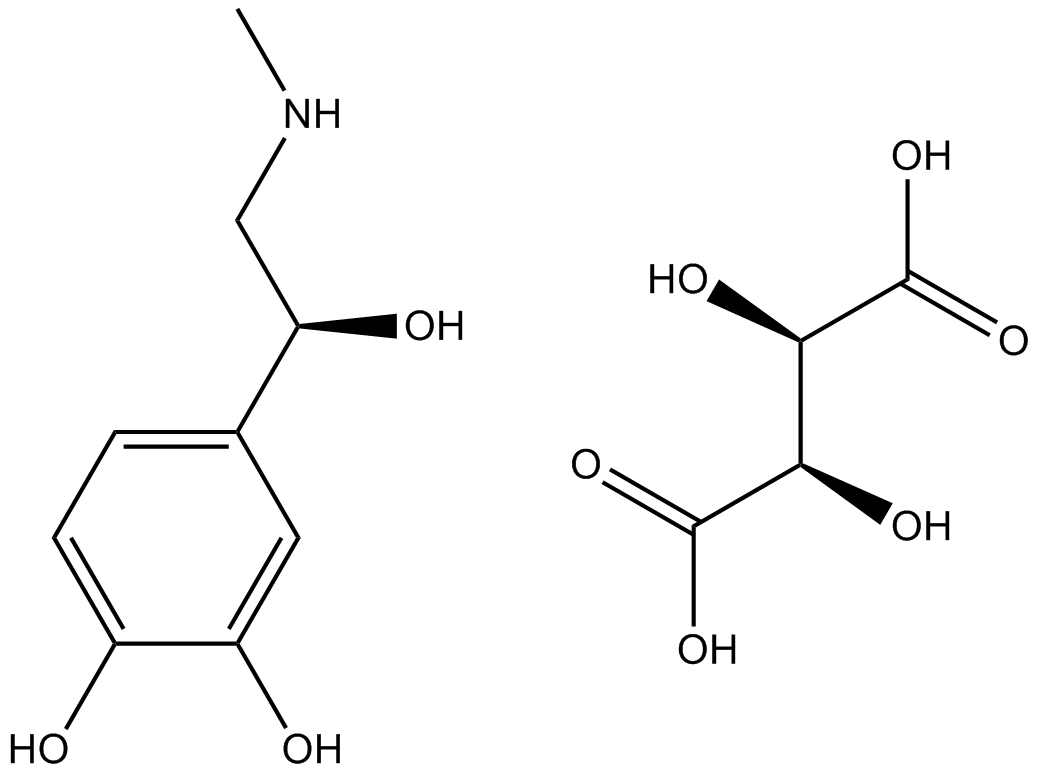
(-)-Epinephrine (+)-bitartrate
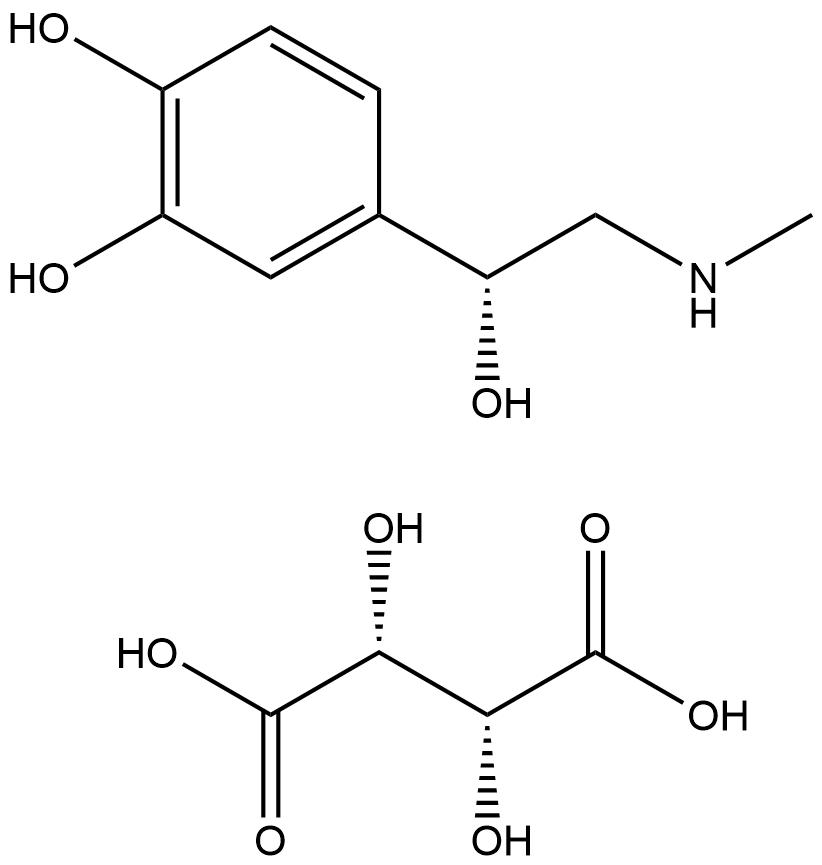
L-Adrenaline bitartrate (CAS No. 51-42-3) is a non-selective adrenergic receptor agonist, with core targets including α₁/α₂ and β₁/β₂/β₃ receptors. It exerts regulatory effects on physiological processes such as vasoconstriction, heart rate modulation, and bronchodilation by activating these receptors. No MIC data are available for this compound; the half-maximal effective concentration (EC₅₀) values for receptor activation are approximately 10 nM for β₁ receptors, 5 nM for α₁ receptors, and 8 nM for β₂ receptors.
Common concentrations for experimental use are as follows: 1 nM–10 μM for in vitro cell function assays. In animal experiments, the dosage for canines is 0.15–0.3 mg per animal via intramuscular injection (IM), and 2–20 mg per animal via intranasal administration (IN).
The clinically effective therapeutic concentrations correspond to multi-scenario dosages:
For allergy/anaphylactic shock: adults receive 0.3–0.5 mg per dose via IM injection of a 1:1000 solution (1 mg/mL); pediatric dosage is 0.01 mg/kg (maximum 0.3 mg).
As an adjuvant for local anesthesia: a 1:200000 concentration (5 μg/mL) is commonly used, which can prolong the duration of anesthesia and reduce bleeding.
Its biological activities are manifested as vasoconstriction, blood pressure elevation, heart rate acceleration, bronchodilation, and inhibition of allergic mediator release. It is indicated for emergency treatment of anaphylactic shock, acute exacerbation of bronchial asthma, and as an adjuvant for local anesthesia. Common adverse reactions include palpitations and hypertension; overdose may induce arrhythmias. It is contraindicated in patients with pheochromocytoma or hyperthyroidism.
References:
[1] Cassidy JP, Phero JC, Grau WH. Epinephrine: systemic effects and varying concentrations in local anesthesia. Anesth Prog. 1986 Nov-Dec;33(6):289-97. PMID: 3544965; PMCID: PMC2148562.
[2] Bodie B, Brodell RT, Helms SE. Shortage of lidocaine with epinephrine: Causes and solutions. J Am Acad Dermatol. 2018 Aug;79(2):392-393. doi: 10.1016/j.jaad.2018.02.035. Epub 2018 Mar 1. PMID: 29477733.
[3] Dretchen KL, Mesa Z, Robben M, Slade D, Hill S, Croutch C, Kappeler K, Mesa M. Intranasal epinephrine in dogs: Pharmacokinetic and heart rate effects. Pharmacol Res Perspect. 2020 Apr;8(2):e00587. doi: 10.1002/prp2.587. PMID: 32302068; PMCID: PMC7164403.
[4] Shaker M, Abrams EM, Sublett JW. Contextual community epinephrine prescribing: Is more always better? Ann Allergy Asthma Immunol. 2023 Aug;131(2):176-184. doi: 10.1016/j.anai.2023.05.012. Epub 2023 May 19. Erratum in: Ann Allergy Asthma Immunol. 2023 Oct;131(4):534. doi: 10.1016/j.anai.2023.08.004. PMID: 37209832.
| Storage | Store at -20°C |
| M.Wt | 333.29 |
| Cas No. | 51-42-3 |
| Formula | C9H13NO3·C4H6O6 |
| Synonyms | L-Epinephrine Bitartrate; Adrenaline Bitartrate |
| Solubility | insoluble in EtOH; ≥16.66 mg/mL in DMSO; ≥22.9 mg/mL in H2O |
| Chemical Name | (R)-4-(1-hydroxy-2-(methylamino)ethyl)benzene-1,2-diol (2R,3R)-2,3-dihydroxysuccinate |
| Canonical SMILES | [C@@H]([C@H](C(O)=O)O)(C(O)=O)O.[C@@H](CNC)(O)C1=CC(O)=C(O)C=C1 |
| Shipping Condition | Small Molecules with Blue Ice, Modified Nucleotides with Dry Ice. |
| General tips | We do not recommend long-term storage for the solution, please use it up soon. |
Quality Control & MSDS
- View current batch:
Chemical structure