
Immunology/Inflammation


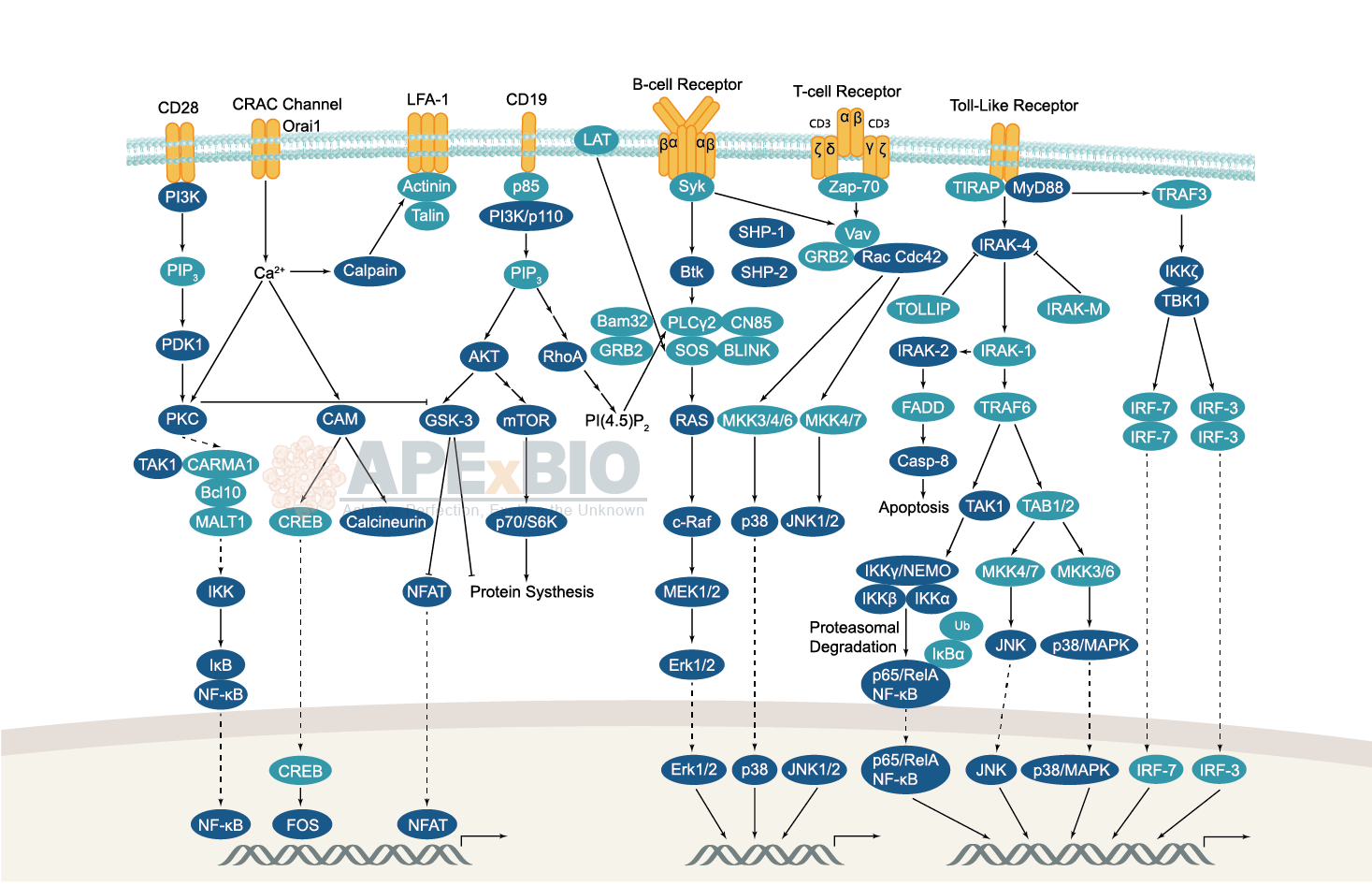
The adaptive immune system consists of B and T lymphocytes which mediate humoral immunity (e.g. antibody response) and cell-mediated immunity, respectively. B cell receptor and T cell receptor signaling is responsible for activation of Src family tyrosine kinases, such as Blk, Fyn, and Lyn in B cells and Fyn and Lck in T cells, resulting phosphorylation of the receptor-associated ITAM motifs. Phosphorylated ITAMs serve as the docking sites for Syk family tyrosine kinases, e.g. Syk in B cells and Zap-70 in T cells. Activated Syk kinases then propagate the signals via phosphorylation of downstream proteins. Furthermore, lymphocyte receptor signaling facilitates B and T cell development, differentiation, proliferation and survival.
-
A9014 NLRP3/AIM2-IN-2 -
A9026 PD-1-IN-17 -
A9027 SM-276001 -
A9036 Hydronidone -
A9057 TNF-α Antagonist TFA -
A9072 MitraphyllineSummary: Major pentacyclic oxindole alkaloid found in Uncaria tomentosa, inhibits lipopolysaccharide-induced activation of primary human neutrophils. -
BA2316 InotuzumabSummary: Inotuzumab (HumanizedAnti-CD22RecombinantAntibody) is humanized, κ-antibody targeted to humans. -
BA2722 TAK-243Summary: TAK-243 (MLN7243) is a first-of-its-kind, selective ubiquitin-activating enzyme, inhibitor. -
BA2729 BrusatolSummary: Brusatol (NSC172924) is a unique pathway inhibitor that sensitizes a wide range of cancer cells to Cisplatin and other chemotherapeutically active molecules. -
BA2730 GSK2795039Summary: GSK2795039 is a NADPH oxidase 2 inhibitor that averaged 6 in different cell-free assays.