DNA Damage/DNA Repair


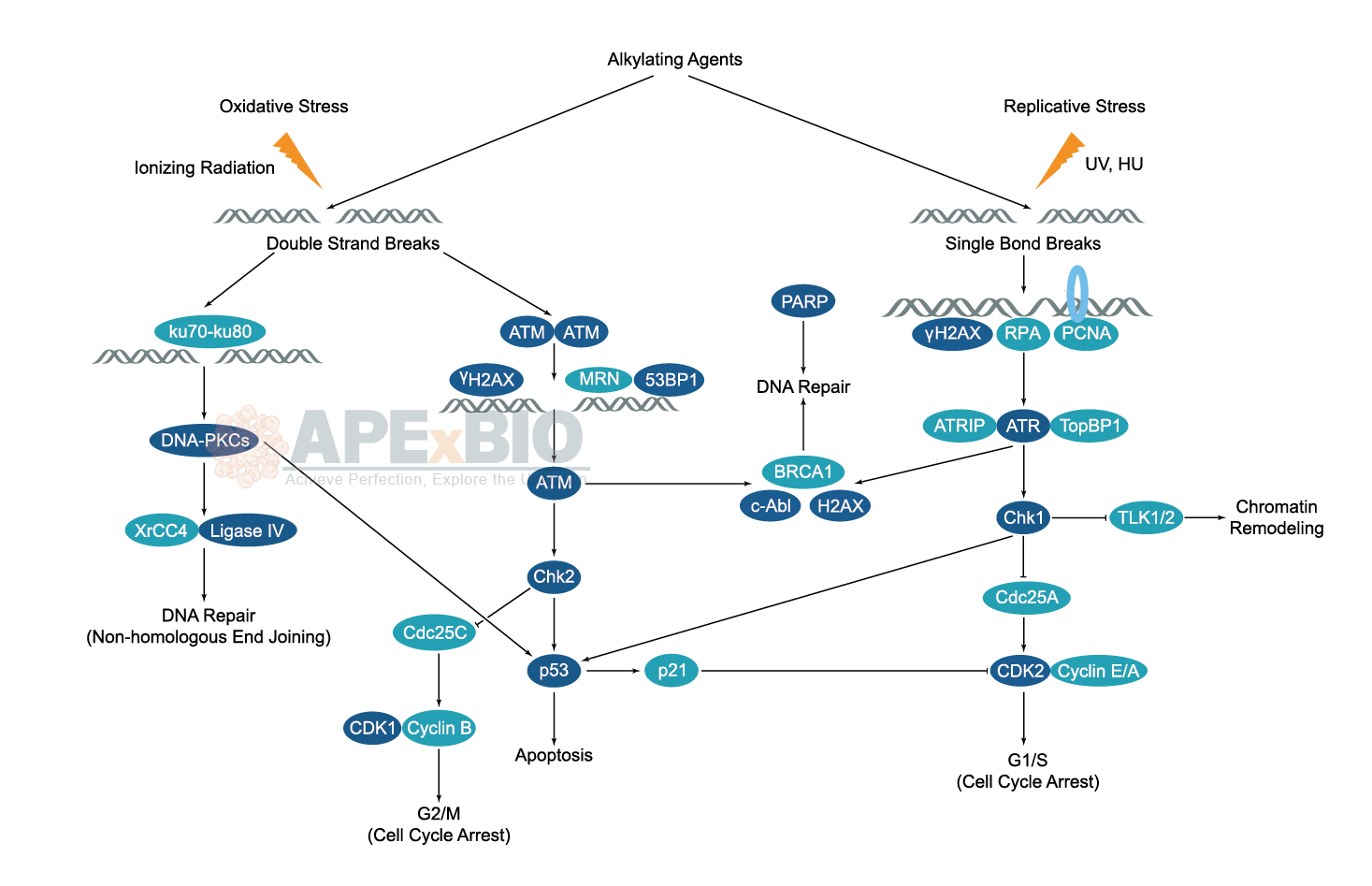
The DNA in a human cell receives tens of thousands of damages per day due to both external (exogenous) and internal (endogenous) stress. The exogenous damages are caused by chemical contamination, UV light, ionizing radiation and alkylation/methylation etc, while the endogenous damages are coming from oxidation, alkylation and hydrolysis of bases etc. Since single strand and double strand breaks of DNA will occur after the damage, unrepaired DNA damage leads to cell senescent, apoptosis and malignancies etc. To overcome this threat, cell has developed DNA damage response, to detect DNA damage and mediate its repair.
DNA repair involves multiple mechanisms such as mismatch, base excision, and nucleotide excision repair etc. A group of proteins and pathways are participated in those processes. ATM/ATR kinases and DNA-PK are crucial for the detection of the DNA damage. Chromatin remodelers regulate chromatin accessibility for the DNA repair factors to function. RPA, Rad51 and the fanconi anemia proteins act directly on repairing the DNA damage. p53 network, the RAS GTPase superfamily, and the ubiquitin system also play important part in the DNA damage response. Aberrant DNA damage response is linked to aging, cancer and immune diseases.
-
A2531 Fluoroorotic Acid, Ultra PureSummary: 5-Fluoroorotic acid -
P10019 Prulifloxacin (Pruvel)Target: Topoisomerases -
A8183 Trichostatin A (TSA)30 CitationTarget: Histone Deacetylases (HDACs)Summary: HDAC inhibitor -
C3722 4-ThiouridineSummary: 4-Thiouridine is a ribonucleoside analog that is widely utilized in RNA analysis and (m)RNA labeling. It also inhibits rRNA synthesis, leading to a nucleolar stress response. -
BA1006 CalicheamicinSummary: Calicheamicin is a tumor antibiotic and potent cytotoxic agent that causes DNA double-strand breaks. -
BA1090 Dox-btn2Summary: Dox-btn2 is a biotinylated derivative with biotin labeling at the point of coupling of 3'-NH to adriamycin. -
BA1116 NovobiocinSummary: An effective orally active antibiotic. Its targets include bacterial DNA gyrase (subunit B, inhibiting ATPase activity) and Hsp90. It can also inhibit bacterial DNA replication, cell membrane synthesis, and vacuole formation. -
BA1210 AVN-944Summary: AVN-944 (VX-944) is an orally effective, selective, non-competitive and specific inhibitor of (inosine monophosphate dehydrogenase). -
BA1310 NevadensinSummary: Nevadensin is a naturally occurring selective inhibitor of human carboxylesterase 1. -
BA1329 MyristicinSummary: Myristicine is an antagonist and weak monoamine oxidase inhibitor with oral bioactivity.