Azithromycin
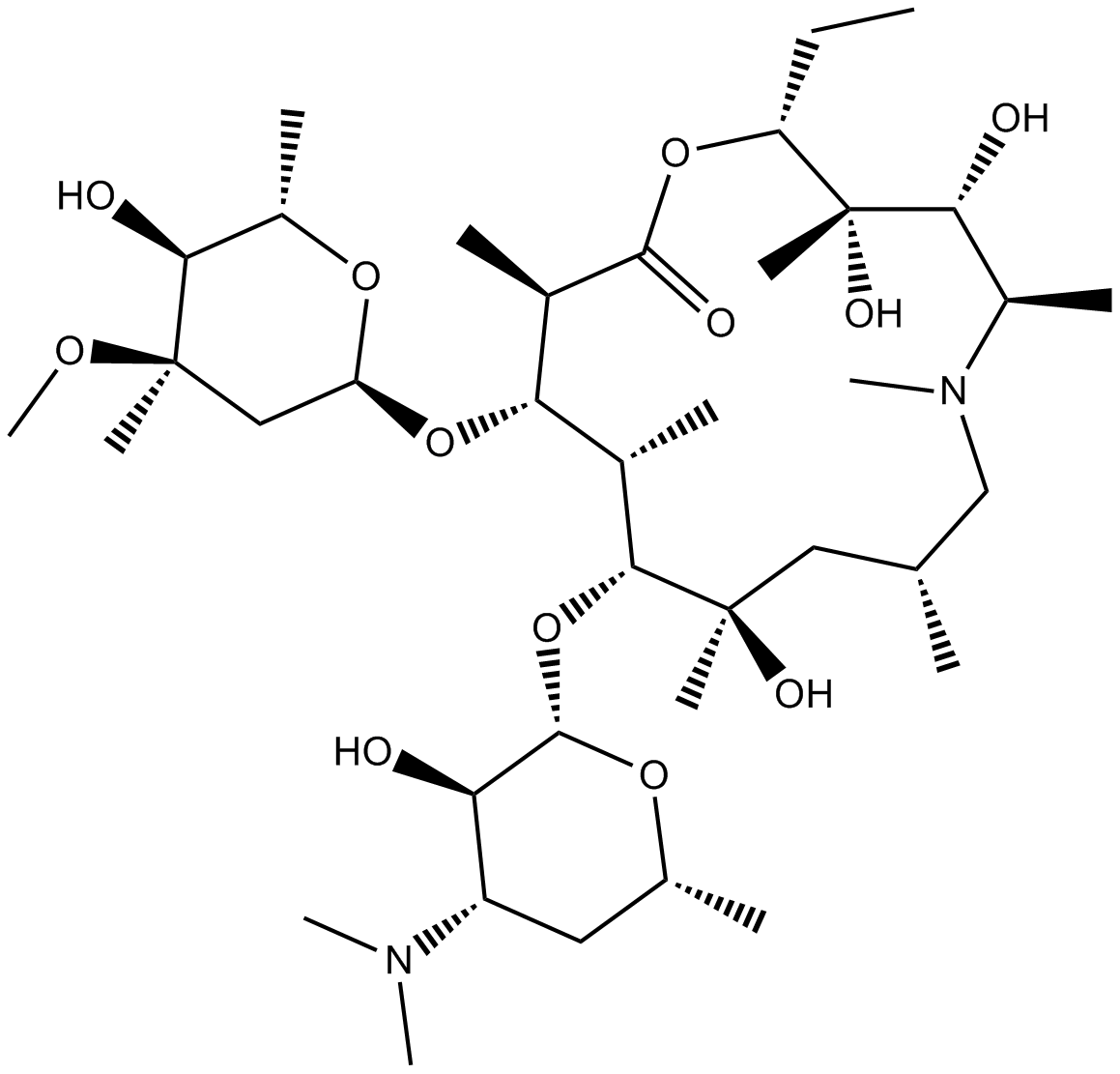
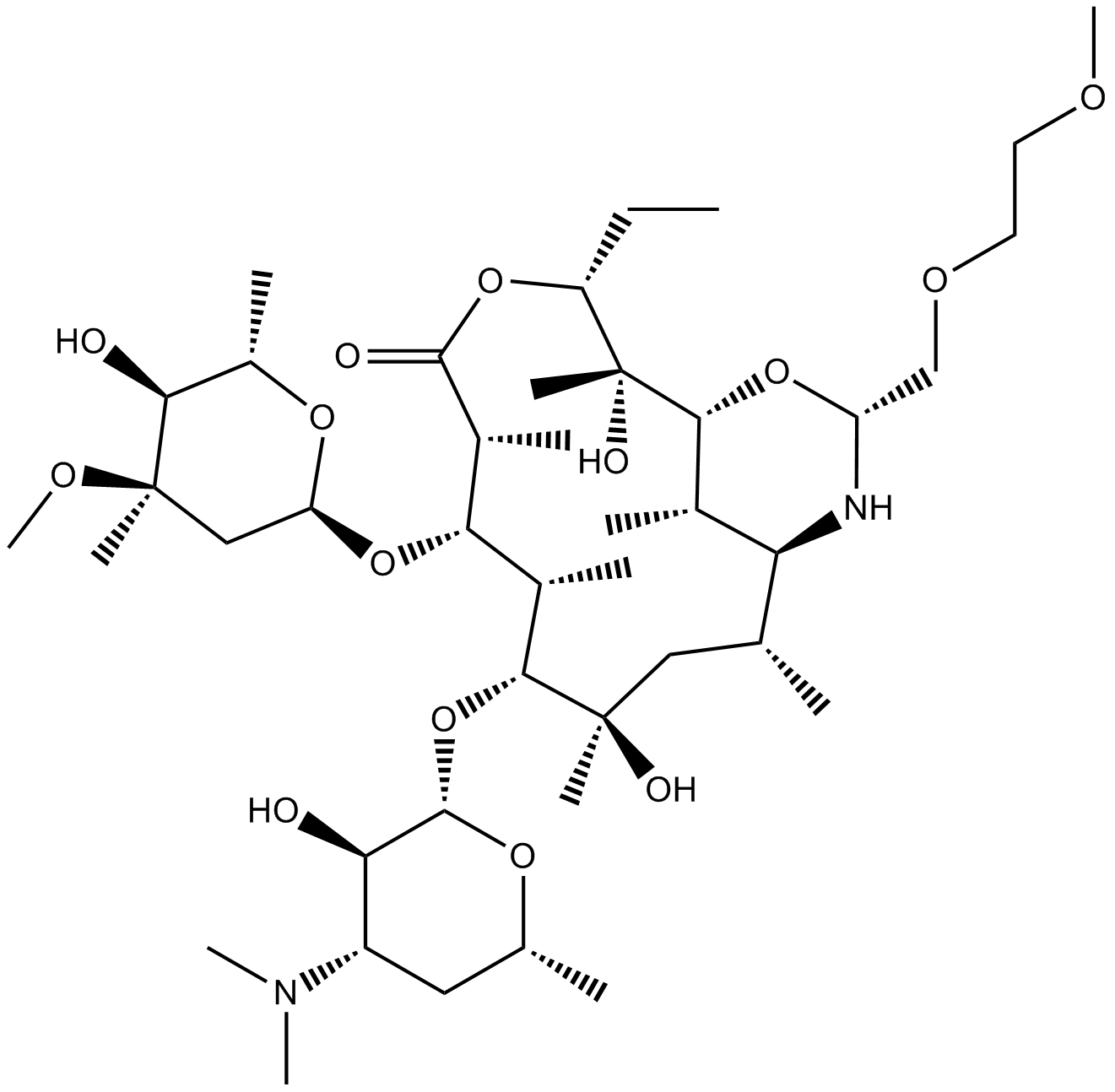
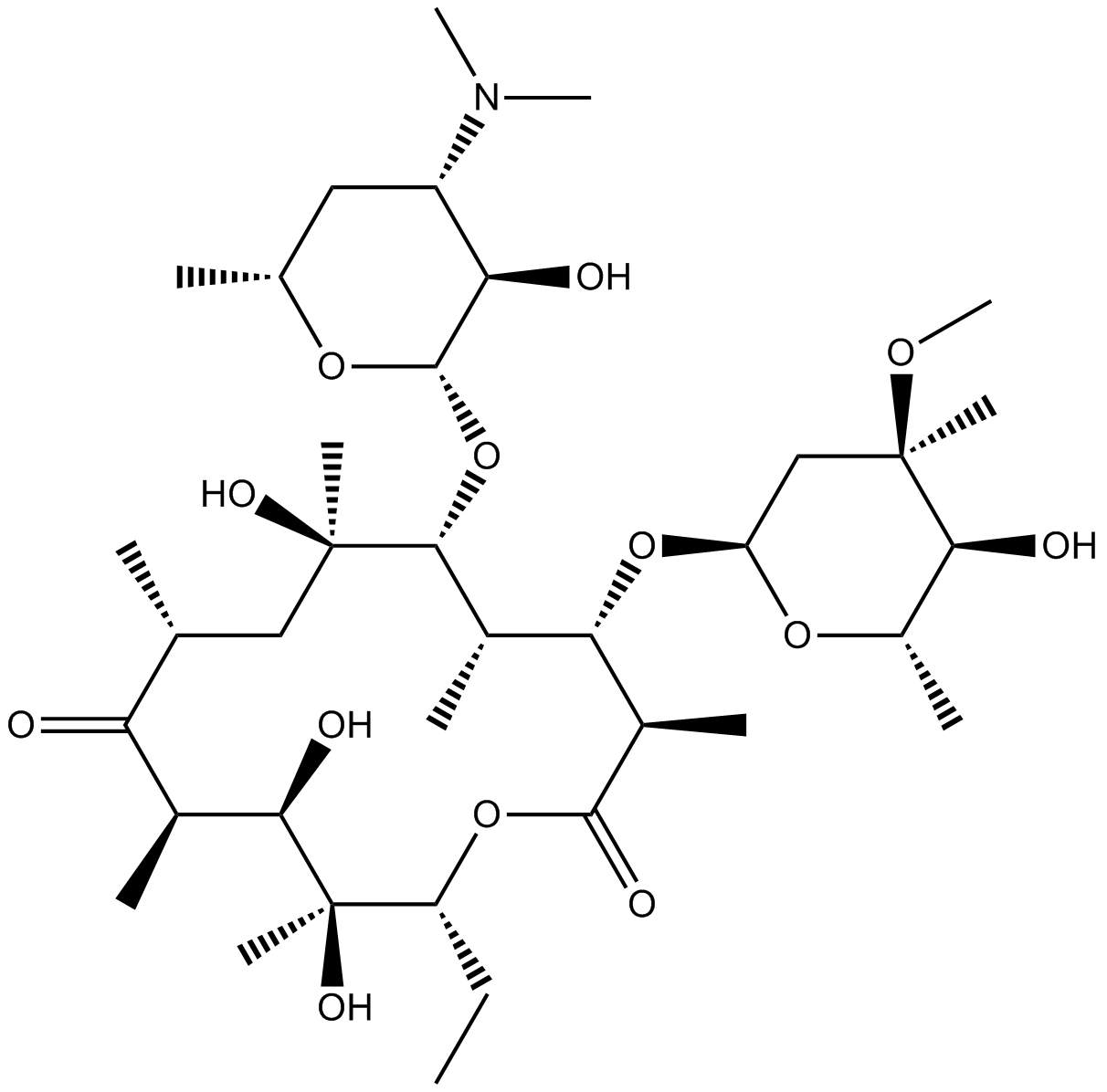
Azithromycin (CAS No. 83905-01-5) is a 15-membered macrolide antibiotic whose core bioactivity is inhibition of bacterial protein synthesis. Its target is the bacterial 50S ribosomal subunit, where it binds to 23S rRNA, affecting the nascent peptide exit tunnel and blocking the translation process. Its MIC shows resistance peptide dependence; for example, the resistance peptide MLLRV has an MIC>200 μg/mL, and MLLLV has an MIC of 120 μg/mL, while the concentration used for screening resistance peptides is 100 μg/mL (corresponding to 1.5 MIC). Common application concentrations: in vitro TLC analysis has a linear range of 5-30 μg/spot, with a quantitation limit of 2 μg/spot; in forced degradation studies, concentrations such as 150 mg/mL (acid/alkali hydrolysis) and 1 mg/20 μL (purity testing) are used; in animal experiments, the concentration added to culture medium for screening resistance peptides is 100 μg/mL. Clinically it is formulated as oral capsules (250 mg/capsule), and the effective therapeutic concentration needs to be adjusted according to clinical indications. It is easily degraded under acidic conditions, and its main impurity is azaerythromycin A (CAS No. 76801-85-9, Cat. No.: BA1060), which has an Rf value of 0.54 in TLC analysis and can be effectively distinguished from impurities and degradation products. It is suitable for the treatment of bacterial infections.
References:
[1] Khedr A, Sheha M. Quantitative thin-layer chromatographic method of analysis of azithromycin in pure and capsule forms. J Chromatogr Sci. 2003 Jan;41(1):10-6. doi: 10.1093/chromsci/41.1.10. PMID: 12597590.
[2] Vimberg V, Xiong L, Bailey M, Tenson T, Mankin A. Peptide-mediated macrolide resistance reveals possible specific interactions in the nascent peptide exit tunnel. Mol Microbiol. 2004 Oct;54(2):376-85. doi: 10.1111/j.1365-2958.2004.04290.x. PMID: 15469510.
- 1. Ng MY, Zhang H, et al. "New in Vitro Assay Measuring Direct Interaction of Nonsense Suppressors with the Eukaryotic Protein Synthesis Machinery." ACS Med Chem Lett. 2018 Nov 21;9(12):1285-1291. PMID:30613341
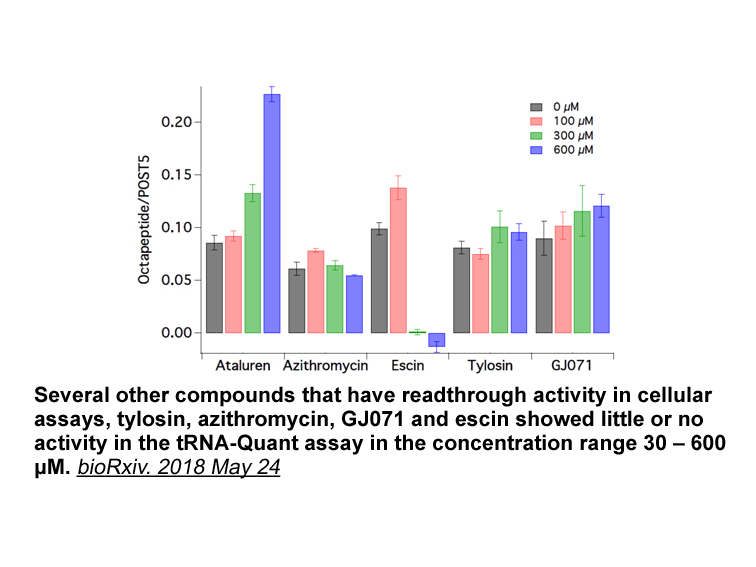
- 2. Martin Y Ng, Haibo Zhang, et al. "A new in vitro assay measuring direct interaction of nonsense suppressors with the eukaryotic protein synthesis machinery." bioRxiv. 2018 May 24.
| Storage | Store at -20°C |
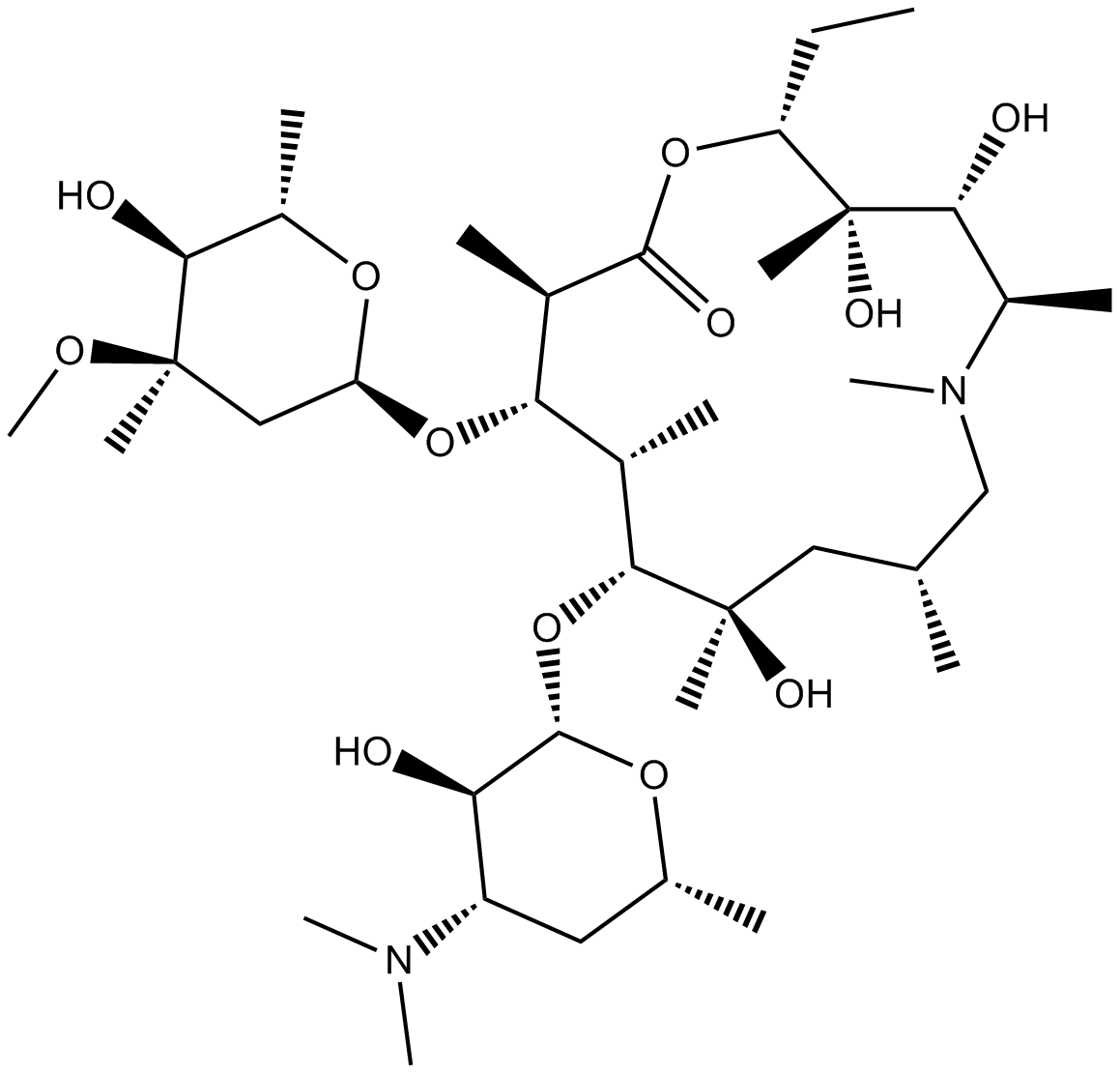
| M.Wt | 748.98 |
| Cas No. | 83905-01-5 |
| Formula | C38H72N2O12 |
| Synonyms | CP 62993 |
| Solubility | ≥75.05 mg/mL in DMSO; insoluble in H2O; ≥102.8 mg/mL in EtOH |
| Canonical SMILES | CCC1C(C(C(N(CC(CC(C(C(C(C(C(=O)O1)C)OC2CC(C(C(O2)C)O)(C)OC)C)OC3C(C(CC(O3)C)N(C)C)O)(C)O)C)C)C)O)(C)O |
| Shipping Condition | Small Molecules with Blue Ice, Modified Nucleotides with Dry Ice. |
| General tips | We do not recommend long-term storage for the solution, please use it up soon. |
| Trypanocidal activity experiment [1]: | |
|
Trypanosomes |
T. congolense, T. b. brucei and T. evansi |
|
Preparation method |
The solubility of this compound in DMSO is > 30.1 mg/mL. General tips for obtaining a higher concentration: Please warm the tube at 37 °C for 10 minutes and/or shake it in the ultrasonic bath for a while. Stock solution can be stored below - 20 °C for several months. |
|
Reacting condition |
0.32 ~ 25 μM; 72 hrs |
|
Applications |
The IC50 values of Azithromycin for T. congolense, T. b. brucei and T. evansi were 0.19 ± 0.17, 3.69 ± 2.26 and 1.81 ± 1.82 μM, respectively. |
| Animal experiment [1]: | |
|
Animal models |
Mice infected with T. congolense |
|
Dosage form |
50, 100, 200, 300 and 400 mg/kg; p.o. |
|
Applications |
In mice infected with T. congolense, Azithromycin dose-dependently killed T. congolense, with the initial clearance of the parasites from the peripheral circulation in all treatment groups. However, this was followed by a relapse resulting in the rapid growth of the parasites. On the other hand, the survival rate was significantly prolonged in all treatment groups. A number of mice survived in the 200, 300 and 400 mg/kg Azithromycin groups, while all mice in the control and the 50 and 100 mg/kg Azithromycin groups died. |
|
Other notes |
Please test the solubility of all compounds indoor, and the actual solubility may slightly differ with the theoretical value. This is caused by an experimental system error and it is normal. |
|
References: [1]. Molefe NI, Yamasaki S, Macalanda AMC, Suganuma K, Watanabe K, Xuan X, Inoue N. Oral administration of azithromycin ameliorates trypanosomosis in Trypanosoma congolense-infected mice. Parasitol Res. 2017 Jul 4. |
|
Quality Control & MSDS
- View current batch:
Chemical structure
Related Biological Data