


Immunology/Inflammation
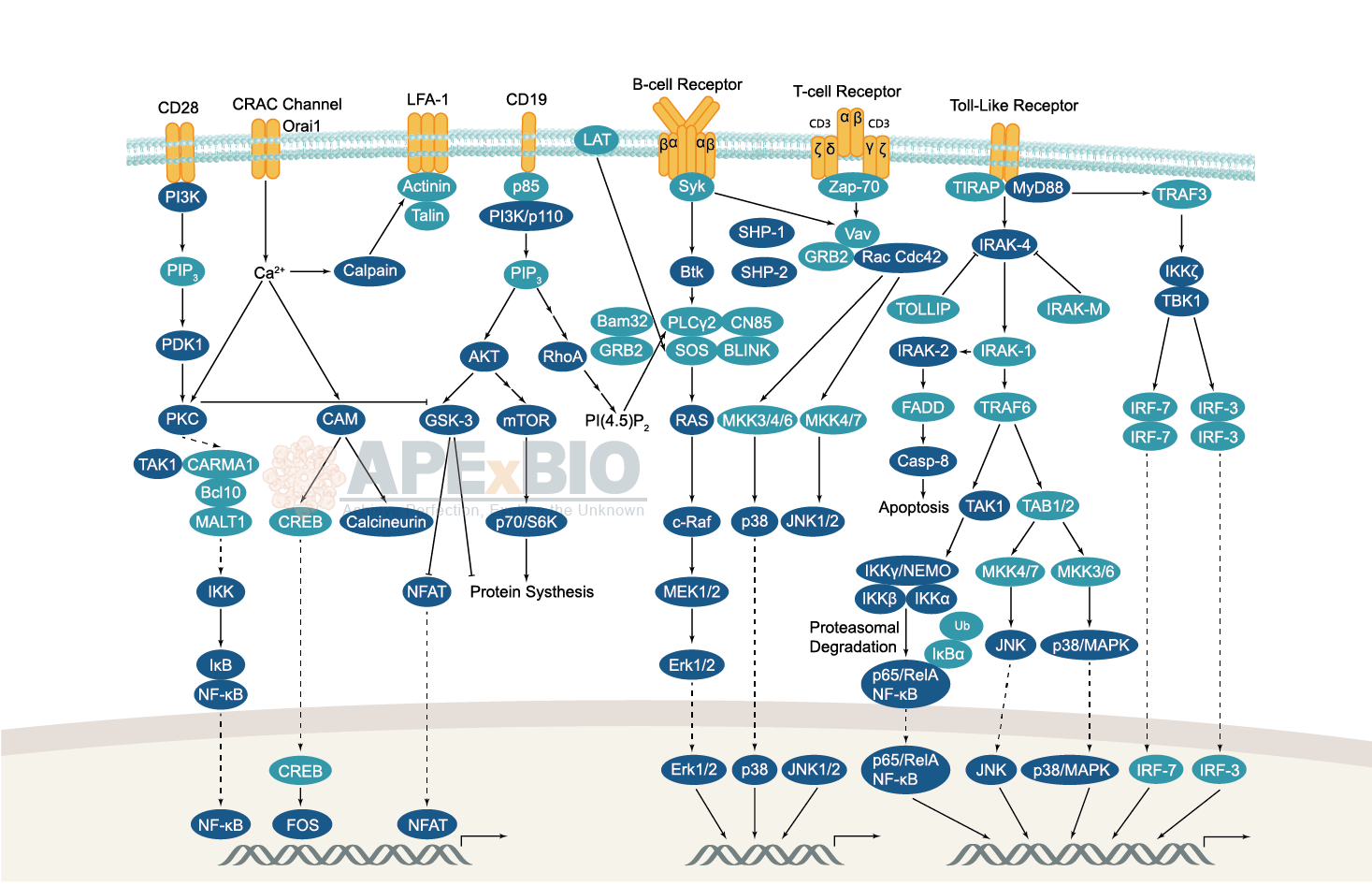
The adaptive immune system consists of B and T lymphocytes which mediate humoral immunity (e.g. antibody response) and cell-mediated immunity, respectively. B cell receptor and T cell receptor signaling is responsible for activation of Src family tyrosine kinases, such as Blk, Fyn, and Lyn in B cells and Fyn and Lck in T cells, resulting phosphorylation of the receptor-associated ITAM motifs. Phosphorylated ITAMs serve as the docking sites for Syk family tyrosine kinases, e.g. Syk in B cells and Zap-70 in T cells. Activated Syk kinases then propagate the signals via phosphorylation of downstream proteins. Furthermore, lymphocyte receptor signaling facilitates B and T cell development, differentiation, proliferation and survival.
-
 BA5732 SulotrobanSummary: Sulotroban (SKF-95587; BM-13177) is a selective antagonist of the thromboxane A2 receptor.
 -
BA5837 JC2-11Summary: JC2-11 is an inflammatory vesicle inhibitor.
-
BA5850 BCL6-IN-6Summary: BCL6-IN-6 is a potent inhibitor of transcriptional repression of B-cell lymphoma 6.
-
BA5870 RBN013209Summary: RBN013209 is a potent inhibitor.
-
BA5944 VudalimabSummary: Vudalimab is a potent and dual inhibitor, a fully humanized bispecific monoclonal antibody.
-
BA5947 TuvonralimabSummary: Tuvonralimab (PSB-205; QL1706) is a dual immune checkpoint blocker.
-
BA5970 FEN1-IN-1Summary: FEN1-IN-1 is an inhibitor.
-
BA6006 CirsilineolSummary: Cirsilineol is a natural flavonoid compound that selectively inhibits IFN-γ/STAT1/T-bet signaling in intestinal T cells.
-
BA6013 TaraxasterolSummary: Taraxasterol is a pentacyclic triterpenoid.
-
BA6022 GIBH-130Summary: GIBH-130 is a potent neuroinflammatory inhibitor.