


DNA Damage/DNA Repair
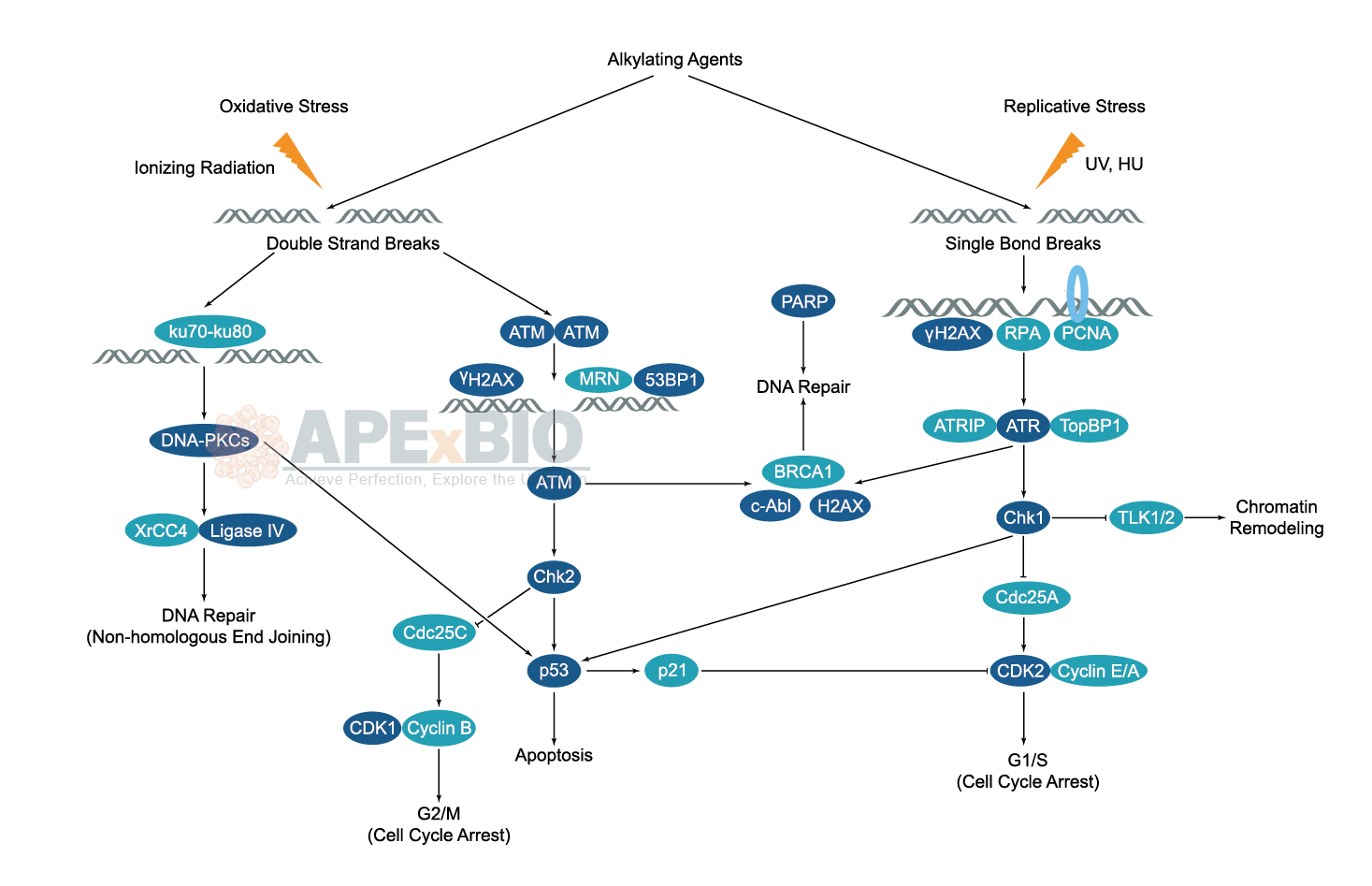
The DNA in a human cell receives tens of thousands of damages per day due to both external (exogenous) and internal (endogenous) stress. The exogenous damages are caused by chemical contamination, UV light, ionizing radiation and alkylation/methylation etc, while the endogenous damages are coming from oxidation, alkylation and hydrolysis of bases etc. Since single strand and double strand breaks of DNA will occur after the damage, unrepaired DNA damage leads to cell senescent, apoptosis and malignancies etc. To overcome this threat, cell has developed DNA damage response, to detect DNA damage and mediate its repair.
DNA repair involves multiple mechanisms such as mismatch, base excision, and nucleotide excision repair etc. A group of proteins and pathways are participated in those processes. ATM/ATR kinases and DNA-PK are crucial for the detection of the DNA damage. Chromatin remodelers regulate chromatin accessibility for the DNA repair factors to function. RPA, Rad51 and the fanconi anemia proteins act directly on repairing the DNA damage. p53 network, the RAS GTPase superfamily, and the ubiquitin system also play important part in the DNA damage response. Aberrant DNA damage response is linked to aging, cancer and immune diseases.
-
 BA4159 BRD2492Summary: BRD2492 is a potent and selective inhibitor.
 -
BA4160 KPZ560Summary: KPZ560 is a potent inhibitor of HDAC.
-
BA4161 TriciferolSummary: Triciferol is a multiligand with combined agonist and antagonist effects.
-
BA4162 HPBSummary: HPB (HDAC6inhibitorHPB) is a selective inhibitor.
-
BA4163 HFY-4ASummary: HFY-4A is an inhibitor.
-
BA4164 HDAC3-IN-1Summary: HDAC3-IN-1 is a potent and selective inhibitor.
-
BA4166 PB94Summary: PB94 is a selective inhibitor (IC=108nM).
-
BA4167 Ac-Lys-AMCSummary: Ac-Lys-AMC is a fluorescent substrate for histone deacetylase.
-
BA4168 NR160
-
BA4169 HDAC2-IN-2Summary: An inhibitor