


Anti-infection
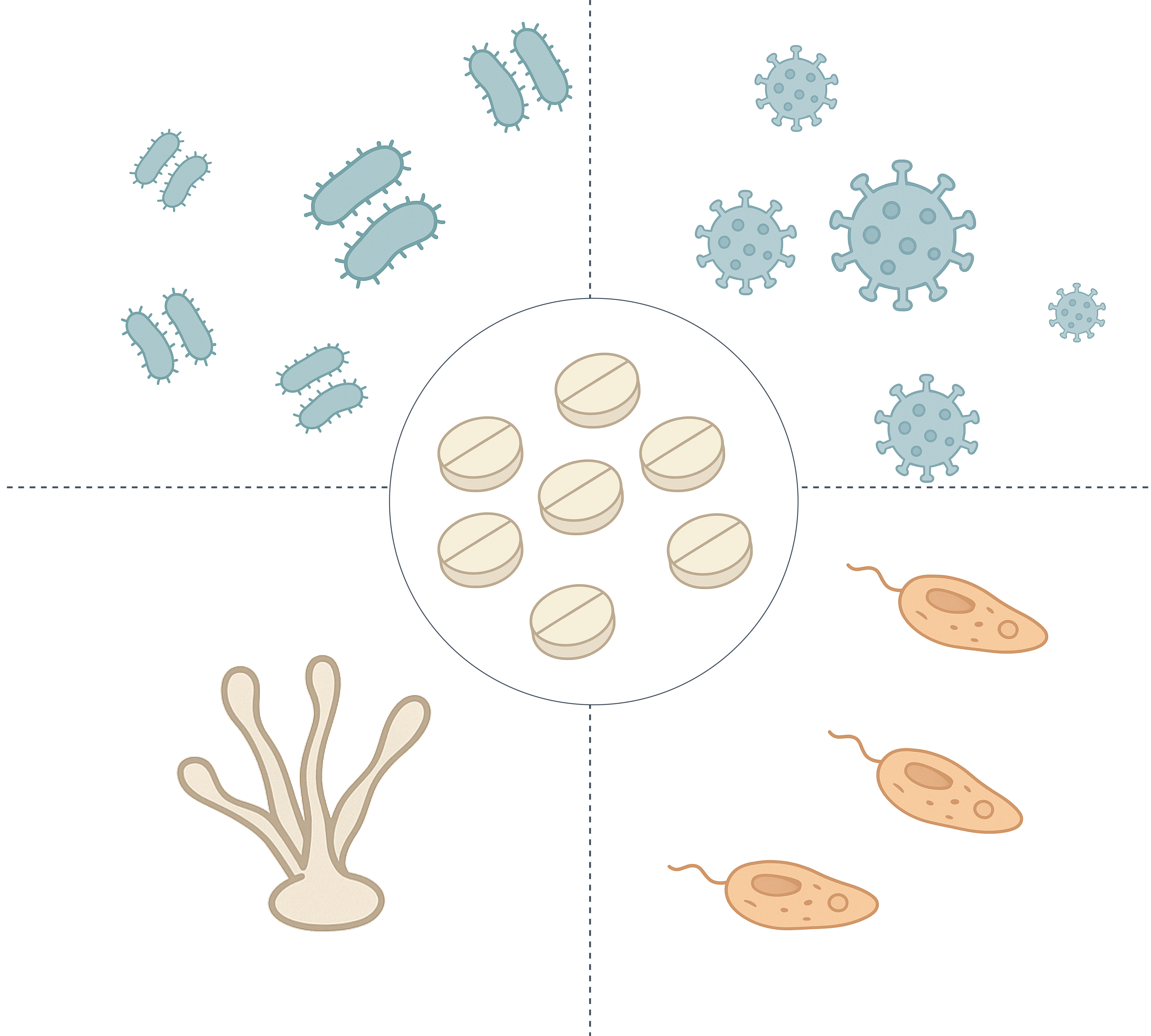
Anti-infectives are agents that eliminate or inhibit the spread of infectious organisms, encompassing antibiotics, antifungals, antivirals, and antiprotozoals.
Antibiotics are a class of antimicrobial agents specifically designed to target bacterial pathogens. They exert their effects by interfering with essential bacterial processes such as cell wall synthesis, protein synthesis, nucleic acid replication, and metabolic pathways, thereby either inhibiting bacterial growth or inducing bacterial death.
Antifungals are antimicrobial agents employed to combat fungal infections (mycoses) in humans and animals. Common antifungal classes include azoles, polyenes, echinocandins, and allylamines, which function by disrupting unique fungal structures or pathways, such as the synthesis or integrity of ergosterol-containing cell membranes and β-glucan-based cell walls, or by interfering with nucleic acid or protein synthesis.
Antivirals are compounds developed to inhibit the replication and spread of viruses within host organisms. Antivirals typically act by blocking viral entry, genome replication, protein processing, or virion assembly and release. Representative examples include nucleoside analogs, protease inhibitors, and neuraminidase inhibitors.
Antiprotozoals are drugs used to treat infections caused by protozoan parasites, including malaria, amebiasis, giardiasis, and trypanosomiasis. They act through a variety of mechanisms, including inhibition of nucleic acid synthesis, interference with mitochondrial function, and disruption of heme detoxification pathways in susceptible parasites.
-
 BA2134 VU041Summary: VU041 was the first submicromolar affinity and channeling inhibitor with values of 2.5 μM and 1.7 μM, respectively.
 -
BA2135 ColumbinSummary: Columbin is an orally active diterpene furanolide with anti-inflammatory and anti-trypanosomal effects.
-
BA2136 BPH-715Summary: BPH-715 is a diphosphate that inhibits Plasmodium hepatic stage growth and, in HepG2 cells, Plasmodium ectoparasite erythrocyte formation.
-
BA2137 WM382Summary: WM382 is an orally effective dual plasma protease inhibitor.
-
BA2138 KDU731Summary: KDU731, an orally active inhibitor that blocks Cryptosporidium infection in vitro and in vivo.
-
BA2139 GSK3494245Summary: GSK3494245 (DDD01305143) is a potent, orally active
-
BA2140 NiclofolanSummary: Niclofolan (BAY9015) is an orally active insect repellent.
-
BA2141 IsofebrifugineSummary: Isofebrifugine is a naturally occurring alkaloid with important physiological activities and favorable pharmacological effects.
-
BA2142 ISPA-28Summary: ISPA-28 is a specific antagonist.
-
BA2143 FenitrothionSummary: Fenitrothion, one of the most widely used organophosphorus pesticides, is a cholinesterase-inhibiting insecticide/acaricide.