Guanethidine Sulfate
Guanethidine Sulfate (CAS No.: 60-02-6) is a well-characterized adrenergic neuron–blocking agent widely used in biochemical and pharmacological research to investigate sympathetic neurotransmission and catecholamine release mechanisms. It selectively enters noradrenergic nerve terminals via neuronal amine transporters and disrupts the storage and release of neurotransmitters such as norepinephrine, thereby serving as a valuable tool for studying presynaptic regulation and neuronal signaling pathways. In vitro studies demonstrate that guanethidine modulates neurotransmitter efflux in a concentration-dependent manner at low micromolar levels, reducing stimulated release while increasing basal leakage, and markedly suppresses electrically evoked contractile responses in isolated smooth muscle preparations, including mouse vas deferens. These inhibitory effects are only partially reversible upon washout and can be significantly influenced by co-treatment with local anesthetics, highlighting interactions with ion channel activity and neuronal excitability. Guanethidine Sulfate is commonly applied in cellular and tissue-based assays, as well as in animal models, to examine adrenergic neuron function, synaptic transmission, and neuroeffector coupling, with experimental concentrations varying according to specific study designs and endpoints.
| Physical Appearance | A solid |
| Storage | -20°C |
| M.Wt | 494.7 |
| Cas No. | 60-02-6 |
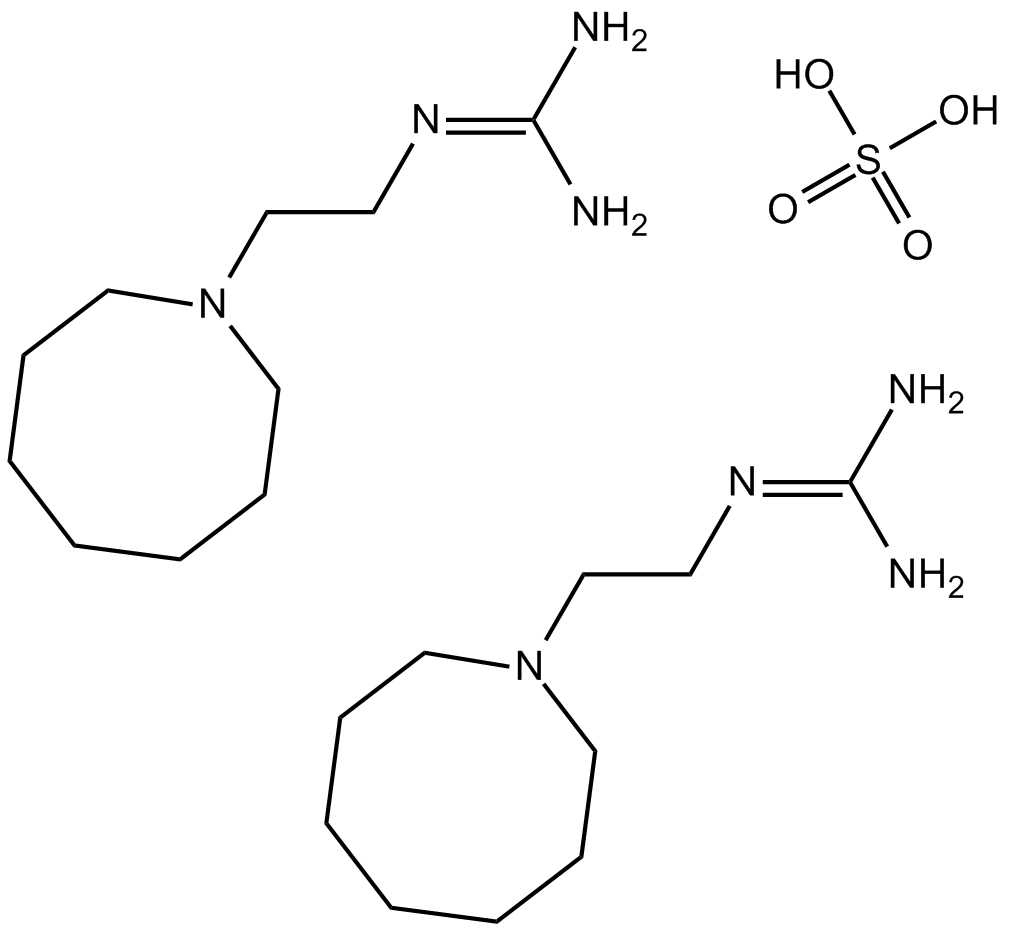
| Formula | C20H44N8·H2O4S |
| Solubility | insoluble in DMSO; insoluble in EtOH; ≥159.4 mg/mL in H2O |
| Chemical Name | 1-(2-(azocan-1-yl)ethyl)guanidine hemisulfate |
| Canonical SMILES | OS(O)(=O)=O.N=C(N)NCCN1CCCCCCC1.N=C(N)NCCN2CCCCCCC2 |
| Shipping Condition | Small Molecules with Blue Ice, Modified Nucleotides with Dry Ice. |
| General tips | We do not recommend long-term storage for the solution, please use it up soon. |
| Cell experiment [1]: | |
|
Cell lines |
the electrically stimulated mouse vas deferens |
|
Preparation method |
This compound is soluble in DMSO. General tips for obtaining a higher concentration: Please warm the tube at 37℃ for 10 minutes and/or shake it in the ultrasonic bath for a while. Stock solution can be stored below -20℃ for several months. |
|
Reacting condition |
3 μM |
|
Applications |
In the electrically stimulated mouse vas deferens, Guanethidine sulfate inhibited twitching by 95%±3% in 15 min, but this effect was only partially reversed after 1 h of washing (33%±12% of control). |
| Animal experiment [1]: | |
|
Animal models |
Myocardial infarction (MI) rat model |
|
Dosage form |
low-dose [LG], 1 mg/kg/day; medium-dose, 3 mg/kg/day; high-dose, 10 mg/kg/day; administered via an osmotic mini-pump for 4 weeks |
|
Application |
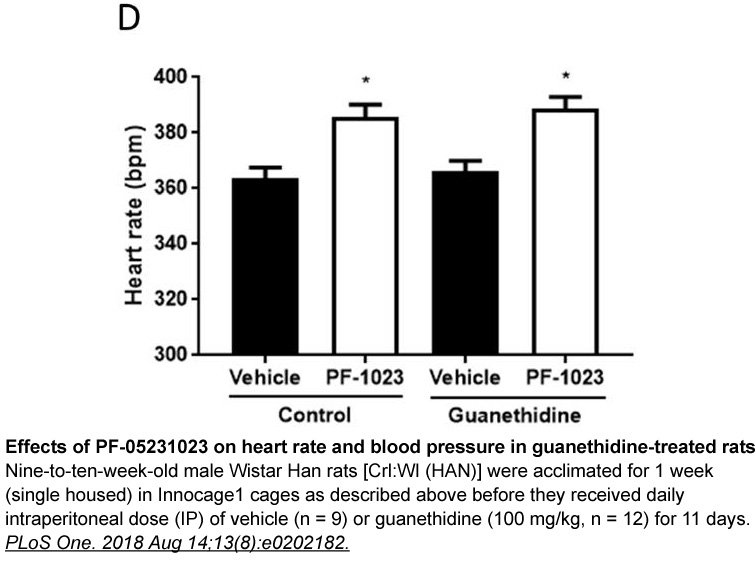
In myocardial infarction (MI) rats, LG suppressed left ventricular (LV) dilation (9.2±0.9 mm vs.11.0±0.8 mm) and improved LV fractional shortening (25.0±4.5% vs. 16.4±4.7%) in association with a reduction of plasma NE levels (520±250 pg/ml vs.1,000±570 pg/ml). Low-dose guanethidine reduced 24-h (6%) and 28-day mortality (6%). High-dose guanethidine also reduced 24-h mortality (12%) but increased 28-day mortality (91%). |
|
Other notes |
Please test the solubility of all compounds indoor, and the actual solubility may slightly differ with the theoretical value. This is caused by an experimental system error and it is normal. |
|
References: [1]. Joyce PI1,Rizzi D,Caló G,Rowbotham DJ,Lambert DG. The effect of guanethidine and local anesthetics on the electrically stimulated mouse vas deferens.Anesth Analg.2002 Nov;95(5):1339-43, table of contents. [2]. Igawa A1, Nozawa T, Fujii N, et al. Long-term treatment with low-dose, but not high-dose, guanethidine improves ventricular function and survival of rats with heart failure after myocardial infarction. J Am Coll Cardiol. 2003 Aug 6;42(3):541-8. |
|
Quality Control & MSDS
- View current batch:
Chemical structure

Related Biological Data