

Cyclophosphamide monohydrate
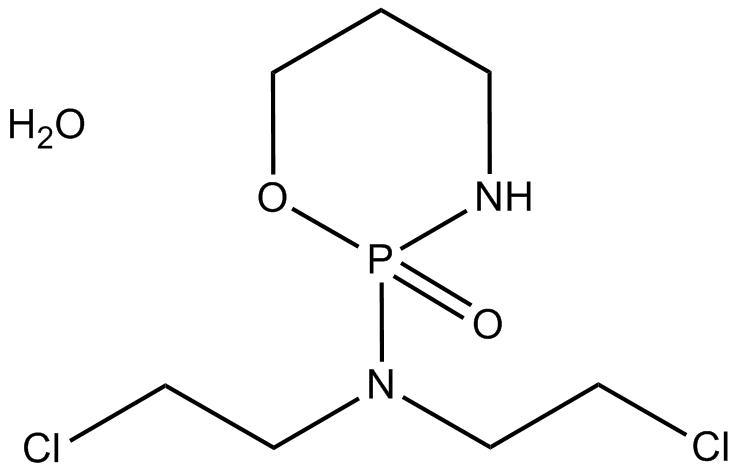
Cyclophosphamide monohydrate (CAS 6055-19-2) is an alkylating agent cytotoxic antineoplastic drug commonly used to establish immunosuppression animal models; its IC50 value against acetylcholinesterase (AChE) is 511 μM.
Cyclophosphamide monohydrate is used in the treatment of childhood cancers. As a prodrug, cyclophosphamide monohydrate is metabolized by cytochrome P-450 enzymes to generate active alkylating species, leading to its cytotoxic effects.
Cyclophosphamide reversibly inhibits AChE with an IC50 of 511 μM. In the control system, the Km value for AChE is 132 μM, which increases by 78% in the CP-treated system. Its inhibition type is linear mixed (partially competitive and noncompetitive). The estimated Ki and KI are 378 and 582 μM, respectively, indicating that its inhibition is predominantly noncompetitive [1].
In carbon tetrachloride-pretreated mice, cyclophosphamide plasma clearance is delayed. Total alkylating activity and plasma levels of 4-hydroxycyclophosphamide rise more slowly and reach lower peaks. However, in terms of AUC, there is no difference between the two groups in plasma total alkylating activity or plasma 4-hydroxycyclophosphamide. Therefore, prolonged tumor cell exposure to 4-hydroxycyclophosphamide may account for the increased antitumor activity of cyclophosphamide following carbon tetrachloride pretreatment [2].
In a trial of 22 children receiving no other treatments known to affect drug metabolism, 9 received fluconazole combination therapy and 13 served as controls; patients receiving the combination had lower plasma cyclophosphamide clearance [3].
References: [1] al-Jafari AA,Duhaiman AS,Kamal MA. Inhibition of human acetylcholinesterase by cyclophosphamide. Toxicology.1995 Jan 19;96(1):1-6.
[2] Harris RN,Basseches PJ,Appel PL,Durski AM,Powis G. Carbon tetrachloride-induced increase in the antitumor activity of cyclophosphamide in mice: a pharmacokinetic study. Cancer Chemother Pharmacol.1984;12(3):167-72.
[3] Yule SM,Walker D,Cole M,μMcSorley L,Cholerton S,Daly AK,Pearson AD,Boddy AV. The effect of fluconazole on cyclophosphamide metabolism in children. Drug Metab Dispos.1999 Mar;27(3):417-21.
| Physical Appearance | A solid |
| Storage | Store at -20°C |
| M.Wt | 279.1 |
| Cas No. | 6055-19-2 |
| Formula | C7H15Cl2N2O2P·H2O |
| Synonyms | Cyclophosphamide hydrate |
| Solubility | ≥13.95 mg/mL in DMSO; ≥51.5 mg/mL in H2O with gentle warming and ultrasonic; ≥96 mg/mL in EtOH |
| Chemical Name | N,N-bis(2-chloroethyl)-2-oxo-1,3,2λ5-oxazaphosphinan-2-amine;hydrate |
| Canonical SMILES | O=P1(N(CCCl)CCCl)OCCCN1.O |
| Shipping Condition | Small Molecules with Blue Ice, Modified Nucleotides with Dry Ice. |
| General tips | We do not recommend long-term storage for the solution, please use it up soon. |
Quality Control & MSDS
- View current batch:
Chemical structure