

Okadaic acid
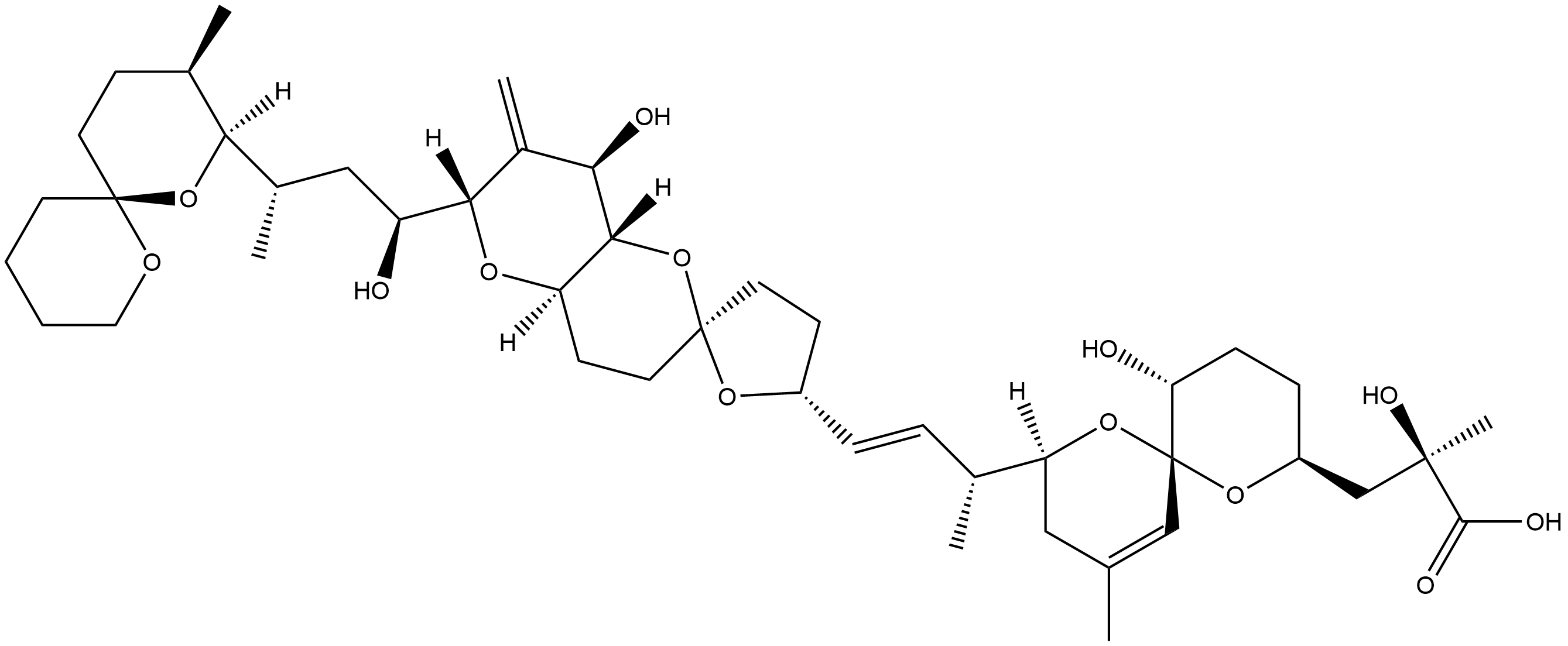
Okadaic Acid (CAS 78111-17-8) is a potent inhibitor of protein phosphatases 1 and 2A, acting on protein phosphatase 1 and protein phosphatase 2A with IC50 values of 19 nM and 0.2 nM, respectively[1].
Protein phosphatase 1 (PP1) and protein phosphatase 2A (PP2A) are two major mammalian serine/threonine protein phosphatases, activated with increasing Ca(2+) cascades and protein kinase A activity[2].
In fused rabbit lens epithelial cells (RLECs), okadaic acid (100 nM) significantly induces apoptosis. In addition, okadaic acid induces expression of p53 and bax, which are required for the apoptotic program. In N/N1003A cells, okadaic acid (10 nM) reduces total phosphatase activity by 20%, mainly inhibiting PP-2A activity, whereas okadaic acid (100 nM) reduces total phosphatase activity by 81%, mainly inhibiting PP-1 and PP-2A activities[3].
In the rat striatum, okadaic acid (0.005, 0.05, and 0.5 nM) dose-dependently increases Elk-1 and CREB phosphorylation and c-Fos immunoreactivity. In addition, okadaic acid (0.05 and 0.5 nM) dose-dependently increases c-fos mRNA expression[2].
Intracerebral injection of okadaic acid inhibits protein phosphatase activity and causes hyperphosphorylation of tau protein, and is commonly used to establish Alzheimer's disease (tau hyperphosphorylation) animal models.
References: [1].Holmes CF. Liquid chromatography-linked protein phosphatase bioassay; a highly sensitive marine bioscreen for okadaic acid and related diarrhetic shellfish toxins. Toxicon, 1991, 29(4-5): 469-477.
[2].Choe ES, Parelkar NK, Kim JY, et al. The protein phosphatase 1/2A inhibitor okadaic acid increases CREB and Elk-1 phosphorylation and c-fos expression in the rat striatum in vivo. J Neurochem, 2004, 89(2): 383-390.
[3].Li DW, Fass U, Huizar I, et al. Okadaic acid-induced lens epithelial cell apoptosis requires inhibition of phosphatase-1 and is associated with induction of gene expression including p53 and bax. Eur J Biochem, 1998, 257(2): 351-361.
- 1. Francesca Vivalda, Marco Gatti, et al. "The PIN1–p38–CtIP signalling axis protects stalled replication forks from deleterious degradation." Nucleic Acids Res. 2025 Apr 10;53(7):gkaf278. PMID: 40207632
- 2. Ilaria Ceppi Maria Rosaria Dello Stritto, Martin Mütze, et al. "Mechanism of BRCA1–BARD1 function in DNA end resection and DNA protection." Nature. 2024 Sep 11. PMID: 39261728
- 3. Giordano Reginato, Maria Rosaria Dello Stritto, et al. "HLTF disrupts Cas9-DNA post-cleavage complexes to allow DNA break processing." Nat Commun. 2024 Jul 10;15(1):5789 PMID: 38987539
- 4. Francesca Vivalda, Marco Gatti, et al. "The PIN1-p38-CtIP signaling axis protects stalled replication forks from deleterious degradation." bioRxiv. June 26, 2024.
- 5. Ananya Acharya, Hélène Bret, et al. "Mechanism of DNA unwinding by MCM8-9 in complex with HROB." Nat Commun. 2024 Apr 27;15(1):3584. PMID: 38678026
- 6. Ananya Acharya, Hélène Bret, et al. "Mechanism of DNA unwinding by hexameric MCM8-9 in complex with HROB." Res Sq. 2023 Jun 26:rs.3.rs-3054483. PMID: 37461676
- 7. Chiara Balbo Pogliano, Ilaria Ceppi, et al. "The CDK1-TOPBP1-PLK1 axis regulates the Bloom's syndrome helicase BLM to suppress crossover recombination in somatic cells." Sci Adv. 2022 Feb 4;8(5):eabk0221. PMID: 35119917
- 8. Bin Chen, Bin Liu, et al. "NDR1 functions as tumor suppressor in glioblastoma by phosphoralation of YAP." Research Square. 11 Mar, 2021.
- 9. Amitha Muraleedharan, Noa Rotem-Dai, et al. "Protein kinase C eta is activated in reactive astrocytes of an Alzheimer's disease mouse model: Evidence for its immunoregulatory function in primary astrocytes." Glia. 2020 Oct 17. PMID: 33068318
- 10. Grigaitis R, Ranjha L, et al. "Phosphorylation of the RecQ Helicase Sgs1/BLM Controls Its DNA Unwinding Activity during Meiosis and Mitosis." Dev Cell. 2020;53(6):706-723.e5. PMID: 32504558
- 11. Xu J, Zhang L, et al. "PP2A Facilitates Porcine Reproductive and Respiratory Syndrome Virus Replication by Deactivating irf3 and Limiting Type I Interferon Production." Viruses. 2019 Oct 15;11(10). pii: E948. PMID: 31618847
| Physical Appearance | A solution in ethanol. To change the solvent, simply evaporate the ethanol under a gentle stream of nitrogen and immediately add the solvent of choice. |
| Storage | Desiccate at -20°C |
| M.Wt | 805.01 |
| Cas No. | 78111-17-8 |
| Formula | C44H68O13 |
| Solubility | Soluble in DMSO |
| Chemical Name | (R)-2-hydroxy-3-((2S,5R,6R,8S)-5-hydroxy-8-((R,E)-4-((2R,4a'R,5R,6'S,8'R,8a'S)-8'-hydroxy-6'-((1S,3S)-1-hydroxy-3-((2S,3R,6S)-3-methyl-1,7-dioxaspiro[5.5]undecan-2-yl)butyl)-7'-methyleneoctahydro-3H,3'H-spiro[furan-2,2'-pyrano[3,2-b]pyran]-5-yl)but-3-en-2 |
| Canonical SMILES | [C@H]([C@H](NC(=O)C1=NC([C@@H](NC[C@@H](C(N)=O)N)CC(N)=O)=NC(N)=C1C)C(N[C@@H]([C@H]([C@@H](C(N[C@H](C(NCCC2=NC(=CS2)C3=NC(C(NCCC[S+](C)C)=O)=CS3)=O)[C@@H](C)O)=O)C)O)C)=O)(O[C@H]4[C@@H](O[C@@H]5[C@@H](O)[C@@H](OC(N)=O)[C@H](O)[C@@H](CO)O5)[C@@H](O)[C@H](O |
| Shipping Condition | Small Molecules with Blue Ice, Modified Nucleotides with Dry Ice. |
| General tips | We do not recommend long-term storage for the solution, please use it up soon. |
| Cell experiment [1]: | |
|
Cell lines |
Rabbit lens epithelial cells, N/N1003A cells |
|
Preparation method |
The solubility of this compound in DMSO is > 10 mM. General tips for obtaining a higher concentration: Please warm the tube at 37 ℃ for 10 minutes and/or shake it in the ultrasonic bath for a while. Stock solution can be stored below -20℃ for several months. |
|
Reacting condition |
10-100 nM, 0-24 h, |
|
Applications |
In confluent rabbit lens epithelial cells (RLECs), okadaic acid (100 nM) within 3 to 24 h significantly induced cell apoptosis. Also, okadaic acid induced the expression of p53 and bax, which were necessary for the apoptotic programs. In N/N1003A cells, okadaic acid (10 nM) decreased total phosphatase activity by 20% and mainly inhibited PP-2A activity, while okadaic acid (100 nM) reduced 81% total phosphatase activity and inhibited PP-1 and PP-2A activity. |
| Animal experiment [2]: | |
|
Animal models |
Adult male Wistar rats |
|
Dosage form |
0-10 mg/kg, 30 min, injection cannula |
|
Application |
Intrastriatal infusion of okadaic acid (0.005, 0.05 and 0.5 nmol) increased CREB and Elk-1 phosphorylation and c-Fos immunoreactivity in the injected dorsal striatum in a dose-dependent manner. Okadaic acid (0.05 and 0.5 nM) increased c-fos mRNA expression in the dorsal striatum in a dose-dependent manner. Okadaic acid (0.05 and 0.5 nmol) at a survival time of 30 min significantly increased c-fos mRNA hybridization signals in the striatum in a dose-dependent manner. Okadaic acid at 0.05 nmol significantly increased pCREB and pElk-1. Okadaic acid (10 nM) inhibited PP-2A activity and okadaic acid (100 nM) inhibited both PP-2A and PP-1 activity. |
|
Other notes |
Please test the solubility of all compounds indoor, and the actual solubility may slightly differ with the theoretical value. This is caused by an experimental system error and it is normal. |
|
References: [1]. Li DW, Fass U, Huizar I, et al. Okadaic acid-induced lens epithelial cell apoptosis requires inhibition of phosphatase-1 and is associated with induction of gene expression including p53 and bax. Eur J Biochem, 1998, 257(2): 351-361. [2]. Choe ES, Parelkar NK, Kim JY, et al. The protein phosphatase 1/2A inhibitor okadaic acid increases CREB and Elk-1 phosphorylation and c-fos expression in the rat striatum in vivo. J Neurochem, 2004, 89(2): 383-390. |
|
Quality Control & MSDS
- View current batch:
Chemical structure

Related Biological Data

Related Biological Data

Related Biological Data