


MTSEA
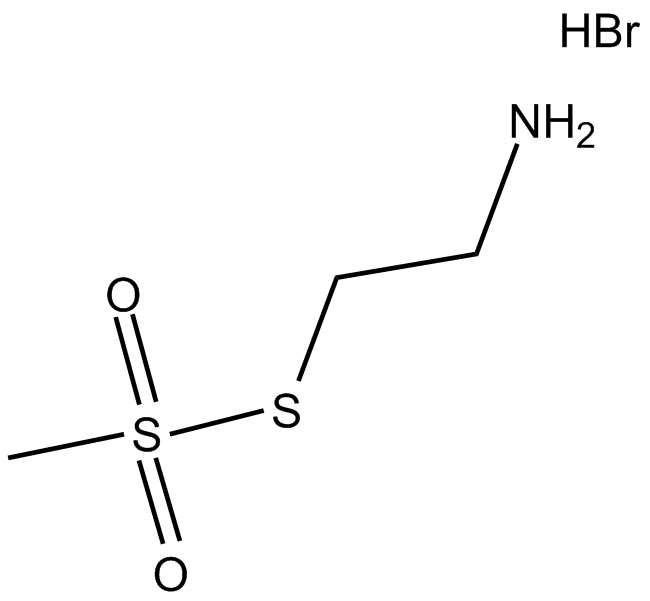





MTSEA (CAS No.: 16599-33-0) is a sulfhydryl-reactive, positively charged methanethiosulfonate reagent widely used in biochemical and pharmacological research for selective modification of free cysteine residues in proteins, resulting in the formation of a lysine-like side chain that alters local charge and steric properties. As a cysteine-specific modifying agent, MTSEA is extensively applied in protein engineering and structure–function studies to investigate amino acid accessibility, conformational dynamics, and intramolecular interactions, particularly in ion channels, transporters, and receptors where substituted cysteine accessibility methods are employed. Its mechanism of action involves covalent interaction with thiol groups, enabling precise probing of protein topology and electrostatic environments within binding sites, thereby providing insights into protein folding, gating mechanisms, and ligand recognition. MTSEA has been shown to modulate enzyme activity and influence signaling pathways by altering critical cysteine residues, with functional effects typically observed at low micromolar to millimolar concentrations depending on protein context and experimental conditions. In vitro and cellular studies commonly utilize MTSEA to map functional domains, assess residue proximity, and evaluate the role of cysteine residues in redox-sensitive or catalytic processes, while its use in more complex biological systems is tailored to specific research objectives and experimental designs.
| Physical Appearance | A crystalline solid |
| Storage | -20°C |
| M.Wt | 236.15 |
| Cas No. | 16599-33-0 |
| Formula | C3H10BrNO2S2 |
| Synonyms | 2-Aminoethyl methanethiosulfonate; Methanethiosulfonate Ethylammonium |
| Solubility | ≤30mg/ml in ethanol;30mg/ml in DMSO;30mg/ml in dimethyl formamide |
| Chemical Name | S-(2-aminoethyl) methanesulfonothioate hydrobromide |
| Canonical SMILES | NCCSS(C)(=O)=O.Br |
| Shipping Condition | Small Molecules with Blue Ice, Modified Nucleotides with Dry Ice. |
| General tips | We do not recommend long-term storage for the solution, please use it up soon. |