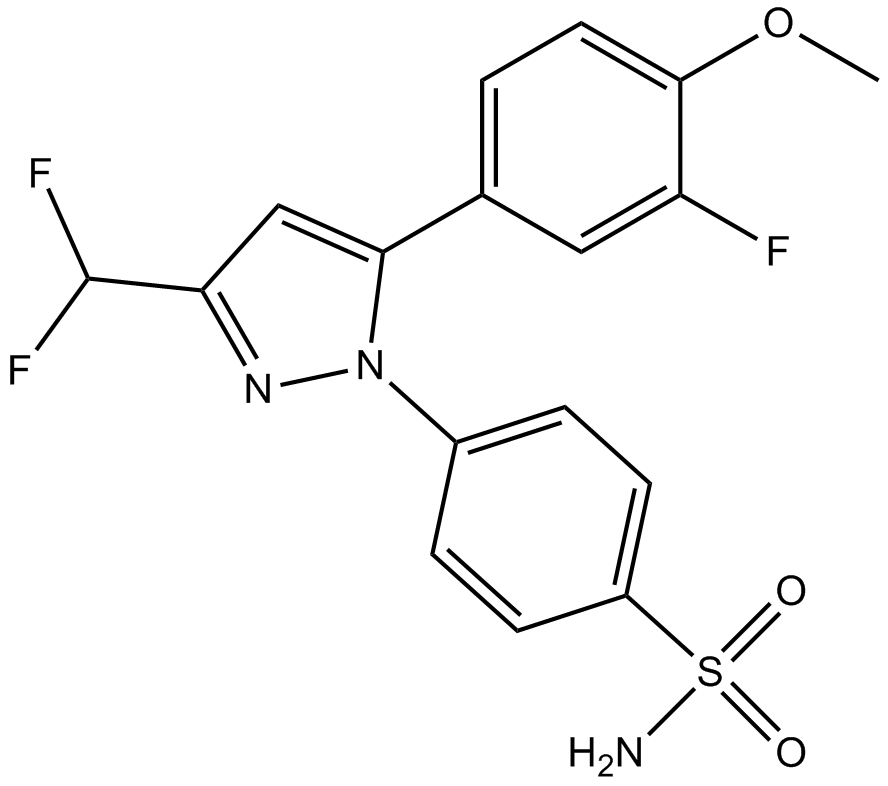
Deracoxib
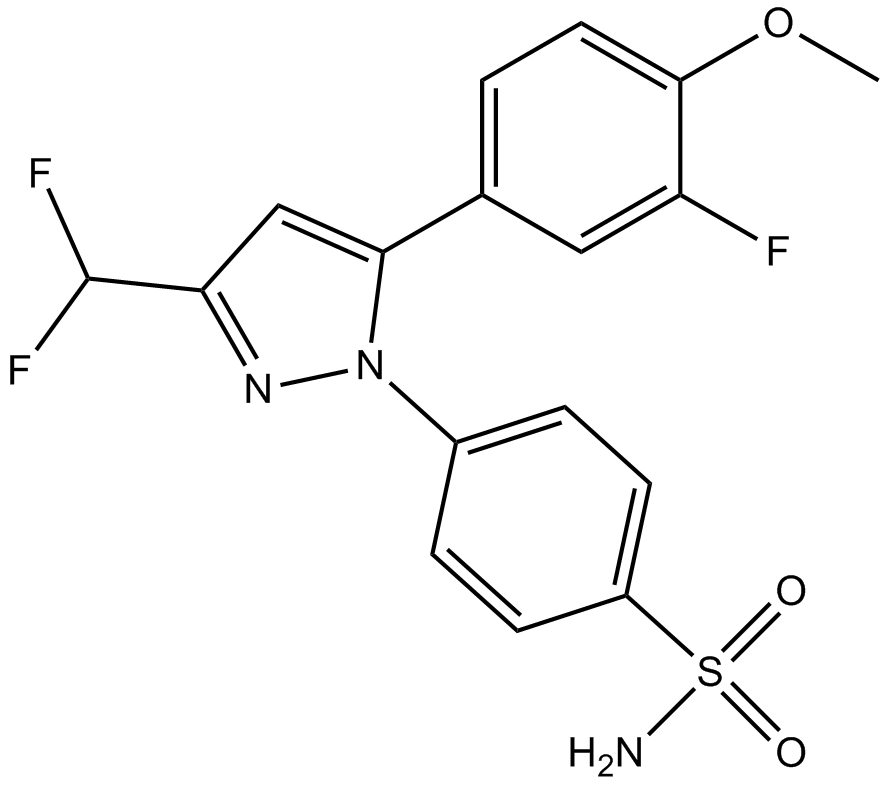





Deracoxib (CAS No. 169590-41-4) is a selective cyclooxygenase-2 (COX-2) inhibitor. Its core bioactivities involve dual anti-inflammatory/analgesic and antitumor effects. Its targets include COX-2, the nitric oxide (NO) synthesis pathway, and apoptosis-related proteins Bcl-2/Bax. It exerts effects by regulating NO production, inducing G?/G? phase arrest and apoptosis in tumor cells, and can synergize with doxorubicin (DOX) to enhance antitumor activity while protecting normal cells. The IC?? values are cell type-specific: 70–150 μM for canine osteosarcoma cells (POS, HMPOS, COS31), and approximately 974.48 μM for the canine mammary carcinoma cell line CMT-U27. Commonly used experimental concentrations: in vitro cell experiments as a single agent, 50–1000 μM; in combination with doxorubicin (Adriamycin, CAS No. 23214-92-8, Cat. No.: A3966) to protect normal cells, 50–250 μM. In animal experiments, the analgesic and anti-inflammatory dose is 4 mg/kg/day (oral), with higher doses up to 8–10 mg/kg/day. Effective therapeutic concentrations in corresponding clinical scenarios: for oral treatment of pain associated with canine osteoarthritis and orthopedic surgery, 4 mg/kg/day yields a plasma concentration of up to 20 μM; high doses of 8–10 mg/kg/day yield a maximum plasma concentration of 75 μM (long-term use requires vigilance regarding toxicity). In the antitumor field, no clinically effective dose has yet been established; in vitro reference concentrations are 50–1000 μM. In combination regimens, deracoxib can reduce the toxicity of chemotherapeutic agents and enhance antitumor efficacy, indicating potential as an adjuvant in canine cancer therapy.
References:
[1] Royals SR, Farese JP, Milner RJ, Lee-Ambrose L, van Gilder J. Investigation of the effects of deracoxib and piroxicam on the in vitro viability of osteosarcoma cells from dogs. Am J Vet Res. 2005 Nov;66(11):1961-7. doi: 10.2460/ajvr.2005.66.1961. PMID: 16334957.
[2] Ustün Alkan F, Ustüner O, Bak?rel T, C?nar S, Erten G, Deniz G. The effects of piroxicam and deracoxib on canine mammary tumour cell line. ScientificWorldJournal. 2012;2012:976740. doi: 10.1100/2012/976740. Epub 2012 Nov 7. PMID: 23251109; PMCID: PMC3518048.
[3] Bakirel T, Ustun Alkan F, Ustuner O, ?inar S, Anlas C, Bilge Sari A. Response of cultured normal canine mammary epithelial cells to deracoxib-doxorubicin combination. Acta Vet Hung. 2017 Sep;65(3):366-381. doi: 10.1556/004.2017.035. PMID: 28956484.
| Storage | Store at -20°C |
| M.Wt | 397.37 |
| Cas No. | 169590-41-4 |
| Formula | C17H14F3N3O3S |
| Synonyms | SC 046; SC 46; SC 59046 |
| Solubility | ≥51.6 mg/mL in DMSO; ≥13.1 mg/mL in EtOH with ultrasonic; insoluble in H2O |
| Chemical Name | 4-[3-(difluoromethyl)-5-(3-fluoro-4-methoxyphenyl)pyrazol-1-yl]benzenesulfonamide |
| Canonical SMILES | COc(ccc(-c1cc(C(F)F)n[n]1-c(cc1)ccc1S(N)(=O)=O)c1)c1F |
| Shipping Condition | Small Molecules with Blue Ice, Modified Nucleotides with Dry Ice. |
| General tips | We do not recommend long-term storage for the solution, please use it up soon. |
Quality Control & MSDS
- View current batch:
Chemical structure